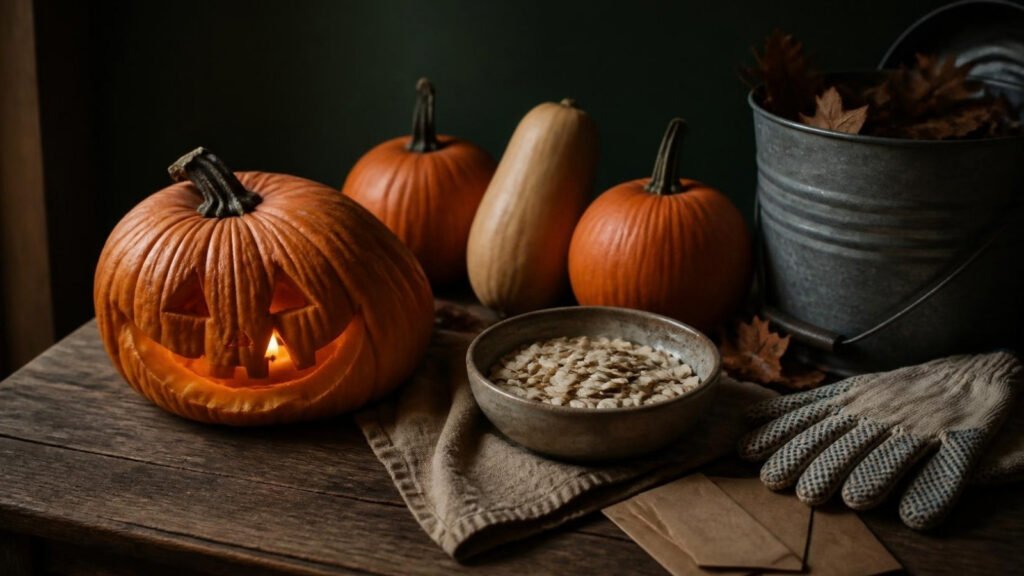
Newspaper on the kitchen table, a bowl of seeds going cold, and a lopsided face with one eye bigger than the other glowing on the porch rail. Duke lies by the door with his nose pointed at the whole operation, hoping someone drops something.
Then Halloween comes and goes, and by the first week of November the grin has slumped and the porch smells a little sweet. Every year it’s the same question at our house: now what do we do with it?
It’s a bigger question than one porch. USDA’s Economic Research Service reports that U.S. growers produced 1.47 billion pounds of pumpkins in 2025, and that about 85 percent of pumpkin acreage in the 2022 Census of Agriculture went to the fresh and ornamental market, the category that includes jack-o’-lanterns and porch decor. EPA estimates that food makes up about 24 percent of the municipal solid waste disposed of in landfills, and that landfilled food waste accounts for about 58 percent of the fugitive methane emissions from those landfills. What happens after carving night decides whether a pumpkin ends up there or back in the soil.
Some links in this post are affiliate links. As an Amazon Associate I earn from qualifying purchases, at no extra cost to you.
A quick note before we start: last week’s post, What to Do With Pumpkin Guts (and Every Other Part of the Pumpkin), covers roasting seeds, guts stock and puree, and why not to eat a carved jack-o’-lantern or leave it out for wildlife. This one is about the jack-o’-lantern’s afterlife, as a family project.
Why a Carved Pumpkin Has Such a Short Life
An uncarved pumpkin is built to last. Its hard rind is a sealed container. University of Missouri Extension horticulturist David Trinklein writes that cured pumpkins and winter squash keep best at 50 to 55°F with low humidity, and can often be stored and eaten until it’s time to plant next year’s crop. His test at the patch: if your thumbnail pierces the rind, it won’t store well.
Carving breaks that seal, opening wet flesh to mold and bacteria. Kansas State University horticulture expert Cynthia Domenghini says carved pumpkins have a much shorter shelf life, “sometimes only a few days up to a week, before noticeable rotting occurs.” K-State adds that candle heat speeds up rotting and a freeze can damage it.
What a Slumping Pumpkin Is Actually Doing
Rot isn’t an ending. A K–2 lesson from the National Agricultural Literacy Curriculum Matrix, “The Case of the Missing Pumpkin,” teaches that decomposition is “a natural process through which nutrients are recycled back into the soil.” Insects, fungi and bacteria break it down into humus that helps soil hold water and nutrients. As the lesson puts it, “The pumpkin doesn’t actually disappear.”
Where I’ll Be Honest With You
Here’s what the sources I read do and don’t support.
- Preservation hacks are tips, not tested results. K-State suggests soaking the inside of a carved pumpkin in a 10 percent bleach solution for several hours. A page on NC State Extension’s Cherokee County site lists petroleum jelly or vegetable oil on the cut edges and refrigerating the pumpkin when it’s not on display. I didn’t find a controlled study comparing any of these. That NC State page also warns that petroleum jelly and oil are flammable near a real candle, and that bleach is only OK if you won’t compost the pumpkin or feed it to animals. We skip the bleach.
- “Glitter pumpkins can’t be composted” depends on who you ask. Oklahoma State University Extension’s Dave Hillock says he doesn’t know that glue, glitter, markers and water-based paints “would be terribly harmful to a compost pile,” though OSU still says to compost only pumpkins without non-biodegradable decorations that can’t be easily removed. Fairfax County, Virginia, says its pumpkin drop-off won’t take pumpkins with paint, glitter or candle wax, because those “cannot be composted.” Drop-off programs set their own rules.
- Pumpkin seeds are not a proven chicken dewormer. It gets repeated, even on an extension volunteer’s page. The one controlled study I found (Acorda and colleagues, Turkish Journal of Veterinary and Animal Sciences, 2019) found pumpkin seed had a moderate effect on some worms and only a marginal effect on another, while the comparison drug cleared the worms completely. The authors call it a “potential” alternative. Ask your vet about parasites.
- Saved jack-o’-lantern seeds probably won’t grow the same pumpkin. University of Maryland Extension says seed saved from hybrid plants won’t reproduce the parent, and that pumpkins, zucchini, acorn squash and yellow crookneck are all Cucurbita pepo and “will all cross with one another.” Plant them anyway, and expect surprises.
What to Do With Your Pumpkin After You Carve It, Ranked
From the move that saves the most to the simplest way to send what’s left back to the ground.
1. Make the One You Carved Last Through Halloween
K-State’s advice is simple: clean the inside thoroughly, removing all seeds and loose strings, keep it cool and out of direct sun, and bring it inside if a freeze is forecast. Swap the candle for LED tea lights. Oklahoma State University Extension lists flashlights, battery-operated flameless candles and glow sticks as safer options. The ASPCA also warns that pets can easily knock over a lit pumpkin and start a fire. In my experience, timing matters most: with a lifespan of days, we carve the weekend before Halloween.
Best for: Every household. It costs nothing and saves you a replacement pumpkin.
2. Carve One, Display the Rest Whole, Eat Them in November
Uncarved pie pumpkins and winter squash on the porch are groceries waiting their turn. A Master Gardener volunteer writing for NC State Extension in Beaufort County says an uncarved pumpkin stored outdoors in cool weather “may still be perfectly edible,” and suggests roasting and pureeing it. West Virginia University’s James Kotcon adds that if the skin is intact, pumpkins may be edible for months. Bring them in before a hard freeze, check for soft spots or mold, and see how to store winter squash. University of Minnesota Extension describes big carving pumpkins’ flesh as stringy and bland and says they’re best used as decorations. So put a sugar pumpkin or butternut next to the big one.
Best for: Families who decorate with pie pumpkins, butternut, acorn or other squash. Your porch display becomes your Thanksgiving soup.
3. Save a Handful of Seeds for Next Year’s Garden
Set aside a few seeds to plant. University of Illinois Extension suggests rinsing them in a colander and letting them dry for about a month. South Dakota State University Extension says seed is dry enough when it snaps cleanly in half, and recommends storing it in a cool, dry place in dry, labeled containers, with the refrigerator as ideal. Seed-saving envelopes are easy for kids to decorate and label. SDSU says most seed stays good for at least three to four years. Here in Missouri, MU Extension’s June gardening tips say to plant pumpkins in mid-June, and that large varieties need a growing season of 100 days or more.
Best for: Kids who like the idea of growing next year’s jack-o’-lantern themselves, and anyone with a sunny corner of yard to spare.
4. Host a Backyard Pumpkin Smash for the Compost Bin
Kids remember this one. Oklahoma State University Extension says carved pumpkins can be composted instead of thrown away, and that cutting or breaking them into smaller pieces speeds up decomposition. NC State’s Beaufort County Master Gardener suggests mixing the chopped pumpkin with browns like leaves or straw. An adult first removes lights, wax and decorations. Then lay a tarp on the grass, hand out kids’ garden gloves, and let them drop pieces from knee height onto the tarp. No tools in small hands. Need a bin? Our DIY compost bin guide walks through a simple build.
Best for: Households with a compost bin or pile, and kids who need to burn off Halloween candy.
5. Bury It in a Garden Bed
No compost bin? Trench composting skips it. University of Nebraska–Lincoln Extension in Lancaster County describes digging a hole about 12 to 15 inches deep and 8 to 10 inches wide, mixing chopped scraps with soil, and covering them with at least 8 inches of soil. It says decomposition takes one month to one year, depending on soil temperature, microbes and the material. An empty November vegetable bed works well, and it pairs with fall garden cleanup. A deep cover also matters if you have a dog. The ASPCA says cut pumpkins can grow mold that could cause a dog to develop tremors or seizures, so I bury ours where Duke can’t dig.
Best for: Gardeners without a compost setup, and anyone who wants richer soil exactly where next spring’s tomatoes will go.
6. Share Fresh Pieces With Backyard Chickens
University of Minnesota Extension says chickens enjoy squash and pumpkins, and reminds keepers to feed treats in moderation, because treats should never replace a balanced ration. I’d only offer fresh, firm pieces, never a moldy jack-o’-lantern. WVU’s Kotcon says painted pumpkins shouldn’t be fed to animals unless they’re peeled. No birds? WVU’s experts suggest asking a local farm, zoo or shelter whether it accepts fresh pumpkins. Call first.
Best for: Chicken keepers with a pumpkin that’s still fresh, or a neighbor with a flock who’d like the extra treat.
Skip entirely: Eating the carved jack-o’-lantern, leaving it out as a wildlife buffet, bleaching a pumpkin you plan to compost or feed to animals, and putting painted or glittered pumpkins into a city collection program. Last week’s pumpkin guts post explains the first two.
Make It a Family Night
Oklahoma State University Extension’s family safety advice is that all carving should be done by an adult. Younger kids can draw the face and scoop out the seeds. Then:
- The seed guess. Before scooping, everyone writes down a guess for how many seeds are inside. Count them in groups of ten on a baking sheet. Closest guess picks the movie.
- Measure the pumpkin. Wrap a string around the widest part to get the circumference, then weigh it on a bathroom scale (weigh yourself holding it, then subtract). Write both down and compare next year.
- The sprout test. Iowa State University Extension’s germination test for saved seeds: count out at least 20 seeds, roll them in damp paper towels, seal the roll in a plastic bag, and keep it at 70 to 80°F. Check after two or three days, then daily for a week. Divide the seeds that sprouted by the seeds you tested. Iowa State says that for most species, 90 percent or more is very good and 50 percent or lower is too low to use.
- The rot watch. Borrowed from “The Case of the Missing Pumpkin” lesson: put a small chunk of pumpkin on a bed of garden soil or compost in a clear container, moisten it, cover it, and record the date, size, shape and color. Once a week, draw what changed. Keep it outside or in the garage, away from pets, and wash hands after checking.
- Smash day. Gloves on, decorations and lights out, tarp down, pieces to the compost bin or garden trench. Adults handle anything with a blade.
The Cost Math
This is an illustrative estimate built on stated assumptions, and the savings here are modest. Prices vary by patch and store, so plug in your own.
- The second jack-o’-lantern. If carving late keeps you from replacing a collapsed pumpkin, you save the full price of one pumpkin.
- The porch squash. If two pie pumpkins or butternuts on the steps become November soup, you skip buying that squash at the store. That saving equals whatever they cost you in October.
- The seed packet. A handful of saved seeds can stand in for a packet next June, though the plants may not match the parent.
Composting and trenching don’t save money directly. They keep the pumpkin out of the landfill, which is what EPA’s methane numbers are about.
Your 3-Step Fix
- Carve one, keep the rest whole. Carve the weekend before Halloween, light it with LED tea lights, and keep it cool and shaded.
- Pull out the keepers. Save a few seeds to dry for next June, and bring the uncarved pumpkins and squash inside to eat in November.
- Return the rest to the soil. Remove the lights and decorations, smash it into small pieces, and compost or bury it deep where pets can’t dig.
Frequently Asked Questions
How long does a carved pumpkin last?
K-State’s Cynthia Domenghini says sometimes only a few days up to a week before noticeable rotting. An uncarved, cured pumpkin kept cool can last months.
Can I eat the pumpkins I used as decorations?
Uncarved ones, often yes, if they’re firm, unpainted and free of soft spots or mold. Carved ones, no. Oklahoma State University Extension says the flesh of a carved pumpkin left at room temperature for hours or days isn’t safe to eat.
Can I plant seeds from my jack-o’-lantern?
Yes, but don’t expect a copy of the parent, since pumpkins cross with other Cucurbita pepo squash and hybrids don’t come true. Dry well, store cool and dry, and in Missouri plant in mid-June.
Is a rotting jack-o’-lantern dangerous for my dog?
It can be. The ASPCA warns that pumpkins, especially once cut, can grow mold that could cause tremors or seizures in dogs, and recommends getting rid of jack-o’-lanterns before they get moldy. The AVMA advises keeping jack-o’-lanterns and lit candles out of pets’ reach. If your dog eats something moldy, call your vet.
Can I compost a painted or glittered pumpkin?
Check first, because drop-off programs set their own rules. Fairfax County, for example, turns away pumpkins with paint, glitter or wax. At home, guidance is mixed, so decorate with removable items or peel off the painted rind first.
Keep Reading
- What to Do With Pumpkin Guts (and Every Other Part of the Pumpkin)
- How to Store Winter Squash
- DIY Zero-Waste Compost Bin
What’s your family’s jack-o’-lantern tradition after Halloween: smash, bury, or something we haven’t thought of? And if you’ve planted seeds from a carved pumpkin, tell me what actually came up.
Want more clean kitchen content like this? Join the MZWK community: a new practical guide every Sunday, without the guilt trip.
Written by Dan Duda
Dan builds software for a living and spends the rest of his time rethinking how his kitchen cooks, stores and shops. He started My Zero Waste Kitchen to share the sourced, practical swaps he actually uses, and to keep plastics and harsh chemicals out of the food he makes. More about Dan
Discover more from My Zero Waste Kitchen
Subscribe to get the latest posts sent to your email.