It’s the Friday after Thanksgiving in mid-Missouri, and the fridge door won’t quite close. Turkey on a foil-tented platter, stuffing balanced on the mashed potatoes, gravy in a measuring cup, half a pumpkin pie wedged in sideways.
Duke, our senior golden retriever, sits in front of the open door like he’s taking inventory. I used to see that fridge and know some of it would end up in the trash. Now I see five or six more meals, as long as I deal with it today.
That dread is common, and the numbers back it up. In a November 2025 analysis, ReFED estimated that 320 million pounds of food would be wasted that Thanksgiving, worth about $550 million, and that 40% of what gets tossed is turkey. On a broader scale, USDA’s Food Safety and Inspection Service (FSIS) notes that USDA estimates 30 percent of the food supply is lost or wasted at the retail and consumer levels. Holiday leftovers are some of the easiest waste to prevent, because you know exactly when they’re coming. Here’s how long Thanksgiving leftovers are good, how to store them safely without much plastic, and how to turn one feast into a week of meals.
Some links in this post are affiliate links. As an Amazon Associate I earn from qualifying purchases, at no extra cost to you.
The Leftover Clock: The Rules That Actually Matter
Leftover safety comes down to a few numbers, and they all come from FSIS. The first clock starts the moment food comes off the stove or out of a warming oven. According to FSIS, leftovers must be refrigerated within 2 hours, or within 1 hour if the temperature is above 90°F. Your refrigerator should hold 40°F or below, and your freezer 0°F or below. If your fridge doesn’t have a built-in thermometer, FSIS suggests keeping an appliance thermometer inside to check.
The second clock is how long food lasts once it’s cold. FSIS says to use refrigerated leftovers within four days or freeze them. Food kept at 0°F stays safe indefinitely, according to FSIS, so freezer times are about quality, not safety:
| Leftover | Refrigerator (40°F or below) | Freezer (0°F, best quality) |
|---|---|---|
| Cooked turkey, plain slices or pieces | 3 to 4 days | 4 months |
| Turkey covered with broth or gravy | 3 to 4 days | 6 months |
| Stuffing | 3 to 4 days | 4 to 6 months |
| Gravy | 3 to 4 days | 4 to 6 months |
| Turkey soup (soups and stews) | 3 to 4 days | 2 to 3 months |
| Pumpkin or pecan pie, baked | 3 to 4 days | 1 to 2 months |
| Custard or chiffon pie, baked | 3 to 4 days | Do not freeze |
Turkey, stuffing and gravy times are from FSIS; soup and pie times are from FoodSafety.gov. For mashed potatoes and other sides, FSIS’s general leftovers guidance applies: 3 to 4 days in the fridge, or 3 to 4 months frozen.
FSIS also says to carve leftover turkey into smaller pieces in shallow containers for rapid cooling (legs and wings can stay whole), to take any stuffing out of the bird’s cavity, and to reheat leftovers to 165°F on a food thermometer, bringing gravy to a rolling boil.
Where I’ll Be Honest With You
Holiday food advice is full of half-truths. Here is what the evidence supports.
- “Let it cool on the counter first” is a myth. FSIS says plainly that hot food can go directly into the refrigerator. The fix for a big pot or pan is dividing it into shallow containers so it cools faster. Leaving it out is how food drifts past the 2-hour mark.
- The smell test can’t tell you whether food is safe. FSIS explains that the bacteria that cause foodborne illness “do not generally affect the taste, smell, or appearance of a food.” An off smell means toss it, but a normal smell is not proof of safety. Go by the calendar.
- Freezer burn and long freezer stays are quality problems, not safety ones. FSIS says freezer burn “does not make food unsafe, merely dry in spots,” and food held at 0°F stays safe past the months in the table. It may just taste flat.
- “Best by” dates on pantry staples are mostly about quality. FSIS says that except for infant formula, product dating isn’t required by federal regulations, and a “Best if Used By” date indicates best flavor or quality, not safety.
- I couldn’t find a federal storage time for homemade cranberry sauce. I use it or freeze it within the same 3 to 4 days as other leftovers. That’s my practice, not an official number.
Holiday Food Storage Best Practices, Ranked by How Much Waste They Prevent
EPA’s Wasted Food Scale ranks preventing waste as the most preferred option, followed by donating food, with landfilling among the least preferred. I ranked these the same way: the earlier in the holiday you act, the more food you save.
1. Plan Portions Before You Shop
The cheapest leftover is the one you never bought. FSIS’s roasting guide says to allow 1 pound of turkey per person, or 1¼ pounds for a frozen pre-stuffed bird. For the sides, the Save The Food campaign from NRDC and the Ad Council offers a free calculator called the Guest-imator. You enter your guests, your dishes and how many leftover meals you want, and it estimates how much of each food to make. I deliberately plan for two or three leftover meals, because planned leftovers get eaten.
Best for: Hosts who end up with three pans of the same casserole every year, and anyone feeding a crowd for the first time.
2. Clear the Fridge and Freezer the Weekend Before
ReFED’s 2025 tips include clearing freezer space for the leftovers you plan to keep. I do a fridge reset the Sunday before: eat up what’s open, freeze what won’t get used, and empty a shelf. That shelf makes the 2-hour rule realistic. A frozen turkey needs the space even earlier. FSIS says to allow about 24 hours of refrigerator thawing for every 4 to 5 pounds, so a 15-pound bird needs three to four days in the fridge.
Best for: Small kitchens with one fridge, and anyone who has ever left a pie in the garage because there was nowhere else to put it.
3. Pack It Up in Shallow Glass Within Two Hours
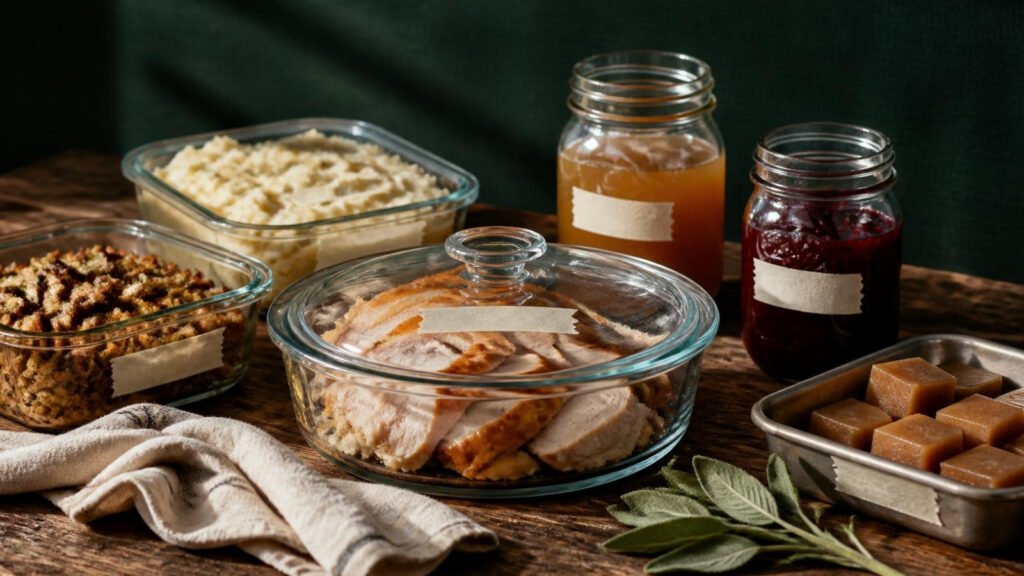
When dessert hits the table, I set a timer. Carve the turkey, split big portions into shallow containers, and cover them, which FSIS says keeps moisture in and odors out. I use glass storage containers because I can reheat in them and skip the plastic wrap (more on why in my post on plastic food containers and heat). Masking tape with the dish name and date goes on every lid, which keeps “first in, first out” honest.
Best for: Everyone, every holiday. This is the step that decides whether leftovers are safe at all.
4. Send Guests Home With Jars
ReFED recommends having to-go containers on hand to send people home with extra food. I save glass jars all year for this, fill them before the 2-hour mark, and write the date on the lid. For long drives I add a cooler with ice. That’s my practice; the rule underneath it is FSIS’s 2-hour limit for perishable food at room temperature.
Best for: Big gatherings, hosts who always overcook, and guests who live alone and would love a ready-made lunch.
5. Freeze Early, in Small Portions
If you won’t eat it by Monday, freeze it Friday, while it’s freshest. I freeze turkey in meal-size portions with a ladle of gravy or broth, which FSIS gives a longer quality window (6 months versus 4 for plain turkey). Soup and broth go into wide-mouth mason jars. Liquids expand as they freeze, so leave space at the top. Penn State Extension’s freezing headspace guidance for liquid packs calls for ½ inch in a wide-mouth pint and 1 inch in a wide-mouth quart. Extra gravy goes into silicone ice cube trays, then into a jar once frozen, so I can pop out two cubes for a weeknight sandwich. (If you made your gravy from frozen stock using my make-ahead turkey gravy method, expect leftover gravy to loosen a little after thawing; whisk it as it comes to a boil.) My full system is in the zero waste freezer blueprint.
Best for: Small households facing a big bird, and anyone who’d rather eat turkey soup in January than turkey sandwiches five days in a row.
Free printable: the MZWK Freezer Tracker and Label Pack (PDF) gives you an inventory sheet for the freezer door (item, date packed, quantity, use-by) and color-coded labels for protein, vegetables, broths and ready meals, so the holiday portions get eaten in order.
6. Donate What’s Untouched, Compost What’s Left
Be realistic about donation. ReFED notes that many food banks and pantries will not accept your leftovers and suggests donating unopened, non-perishable ingredients instead; EPA advises calling your food bank first to ask what it takes. EPA also says the Bill Emerson Good Samaritan Food Donation Act protects donors, including individuals, who don’t act with negligence or intentional misconduct. For scraps, composting keeps food out of the landfill, and EPA says wasted food accounts for 58% of landfill methane emissions released to the atmosphere. Here’s how we built our bin. I keep cooked bones and greasy leftovers out of our backyard pile, which is my practice rather than an official rule; ReFED points to municipal or community composting as another option.
Best for: The extra cans of pumpkin and boxes of stuffing mix you didn’t open, and the vegetable trimmings from a full day of cooking.
Skip entirely: Leaving the spread out all afternoon for grazing, cooling a stockpot on the stovetop overnight, storing the whole turkey on the bone, and sharing scraps with the dog. AVMA warns that poultry bones can damage a pet’s digestive tract and that fat or skin can trigger pancreatitis, and ASPCA notes that onions and garlic, common in stuffing, can be toxic to pets. Duke gets his own food and a lot of sympathy, and the carcass goes out in a tightly closed bag, as AVMA advises.
Leftover Remix: A Week of Meals From One Feast
This is the plan I use, built around the four-day refrigerator window. Thanksgiving is Thursday, so Monday is the last day for anything still in the fridge. These are kitchen practices, not tested recipes, so adjust to what you have. Reheat leftovers to 165°F as you go.
- Thursday night: start the broth. Pull the last meat off the carcass, then simmer the bones for a few hours with water and the onion ends, celery leaves and carrot peels saved during prep. Strain, divide into shallow containers to cool, as FSIS recommends for large pots, then refrigerate or freeze in jars with headspace. More ideas are in my root-to-stem recipes.
- Friday: potato cakes, then freeze day. Mix cold mashed potatoes with an egg and a spoonful of flour, shape into patties, and pan-fry until crisp and hot through. Top with a fried egg and cranberry sauce. After one more round of the classic plate, freeze turkey portions in gravy, extra stuffing and half the broth.
- Saturday: stuffing waffles and vegetable hash. Stir a beaten egg into a few cups of stuffing, press into a hot, greased waffle iron, and cook until crisp; top with turkey and gravy brought to a rolling boil. For dinner, crisp chopped roasted vegetables and sweet potatoes in a skillet, add diced turkey, and cook eggs right in the pan.
- Sunday: turkey and wild rice soup. Sauté onion, carrot and celery, add the broth, cooked wild rice and shredded turkey, and simmer until hot. Freeze what you won’t finish.
- Monday: turkey pot pie to finish the fridge. Combine the last turkey, vegetables and gravy, top with pie crust or biscuit dough, and bake until bubbling. Anything left after Monday goes in the freezer or the compost.
- Anytime: pie and cranberry upgrades. Layer pumpkin pie and plain yogurt for a breakfast parfait. Stir cranberry sauce into oatmeal or whisk it with olive oil and vinegar for a dressing. Fold mashed sweet potatoes into your usual muffin batter in place of some of the liquid.
- The following weeks: the freezer stash. Gravy cubes for open-face sandwiches, soup for busy nights, turkey for enchiladas. I fold these into my Sunday meal planning so they get used in December, not discovered in March.
The Cost Math
I won’t quote turkey prices, because they change every year. But ReFED’s estimate of $550 million worth of food across 320 million pounds works out to roughly $1.70 per wasted pound. That’s simple division on ReFED’s national totals, not a store price.
Here is an illustrative estimate built on stated assumptions. Say you host ten people and, using FSIS’s 1-pound-per-person guide, a 10-pound turkey would cover dinner. You buy a 16-pound bird on purpose, leaving about 6 extra pounds on the bone. Turned into broth, soup, pot pie and frozen portions, that extra might replace five or six dinners you’d otherwise shop for. Thrown out, it’s money spent on meals you never got. The savings aren’t in buying less. They’re in eating what you already paid for.
The tools pay for themselves slowly. A set of glass containers, a few jars and a digital food thermometer last for years, and the thermometer is the only way to confirm that leftovers reached the 165°F FSIS recommends.
Your 3-Step Fix
- Before the holiday, plan portions and clear space. Use 1 pound of turkey per person as your base, decide how many leftover meals you actually want, and empty a fridge shelf and part of the freezer.
- Within 2 hours of the meal, pack it all away. Carve the turkey, use shallow covered containers, label everything with the date, and fill to-go jars for guests.
- By Friday, decide what gets frozen. Anything you won’t eat by Monday goes into the freezer now, in small portions, and the bones go into a broth pot.
Frequently Asked Questions
How long are Thanksgiving leftovers good in the fridge?
FSIS says cooked turkey, stuffing, gravy and other cooked dishes keep 3 to 4 days in a refrigerator at 40°F or below. For a Thursday dinner, that means Sunday or Monday. Freeze anything you won’t finish by then.
Can you freeze Thanksgiving leftovers?
Yes. FSIS lists plain turkey at 4 months for best quality, turkey in gravy at 6 months, and stuffing and gravy at 4 to 6 months. FoodSafety.gov says not to freeze custard or chiffon pies. Food kept at 0°F stays safe beyond those times.
Is it safe to put hot leftovers straight into the fridge?
Yes. FSIS says hot food can go directly into the refrigerator. Divide large amounts into smaller, shallow containers so they cool quickly, rather than leaving them on the counter.
Do I have to throw out freezer-burned turkey?
No. FSIS says freezer burn doesn’t make food unsafe, just dry in spots. Trim the dry areas, or use the meat in soup or pot pie, where texture matters less.
Can my dog have Thanksgiving leftovers?
It’s safest to skip them. AVMA warns that poultry bones can damage a pet’s digestive tract and that fat or skin can trigger pancreatitis. ASPCA notes that onions and garlic can be toxic to pets and that xylitol in desserts can be deadly. If your dog eats something it shouldn’t, call your veterinarian.
Keep Reading
- The Zero Waste Freezer Blueprint
- Root-to-Stem Recipes That Cut Kitchen Waste
- How to Build a DIY Zero Waste Compost Bin
What’s the one Thanksgiving leftover that always goes to waste in your house, and what’s the best thing you’ve ever turned leftovers into? Tell me in the comments, and I’ll add the best ideas to next year’s remix list.
Want more clean kitchen content like this? Join the MZWK community: a new practical guide every Sunday, without the guilt trip.
Written by Dan Duda
Dan builds software for a living and spends the rest of his time rethinking how his kitchen cooks, stores and shops. He started My Zero Waste Kitchen to share the sourced, practical swaps he actually uses, and to keep plastics and harsh chemicals out of the food he makes. More about Dan
Free printable: get the 7-Day Kitchen Reset Kit, a daily checklist, a week-long waste audit, fridge labels and a use-it-up planner, plus a new guide every Sunday.
Discover more from My Zero Waste Kitchen
Subscribe to get the latest posts sent to your email.