The bag comes home at 4:15. You unzip it and there’s the sandwich, still in its baggie, sweating. The ice pack went soft somewhere around second period. The little plastic tray that promised five compartments has a hairline crack down the middle divider, and the applesauce has been quietly migrating into the crackers since about ten in the morning.
It was packed at 7:04 a.m. It was eaten — some of it — at 11:40. Nobody thought about the four and a half hours in between.
Last month I wrote about the car as a 130-degree oven for plastic food containers. A lunchbox is the same problem in miniature: a sealed, warm, unventilated space holding your kid’s food for most of the school day. Same mechanism, smaller box, higher stakes. And August is when you actually have a chance to fix it, because you’re already standing in the lunch aisle with a list.
Some links in this post are affiliate links. As an Amazon Associate I earn from qualifying purchases, at no extra cost to you.
The Four-Hour Warm Window Nobody Accounts For
Here are the actual numbers, not vibes. The USDA’s Food Safety and Inspection Service defines the bacterial “Danger Zone” as 40°F to 140°F. Their guidance for bag lunches specifically is that perishable food should not sit at room temperature for more than two hours — and only one hour if the temperature is above 90°F.
Now do the arithmetic on a normal school day. Packed at 7. Eaten at 11:40. That is roughly four and a half hours. The allowance is two. A backpack in a hallway is not 90°F, but it is not a refrigerator either, and a locker or a bus in early September in most of the country is warmer than your kitchen.
The USDA’s own fix is blunter than most parents realize. They recommend at least two cold sources — two frozen gel packs no smaller than 5×3 inches each, or one gel pack combined with a frozen juice box or a frozen bottle of water. Two. Not the single thin sleeve that came free with the lunch bag. If you keep one thing from this post, keep that.
This is where the plastic question and the food-safety question stop being separate conversations. Warm food in a plastic container is warm food in contact with warm plastic for four hours, every school day, roughly 180 times a year. Most states land on 180 instructional days; the range across states runs about 160 to 186. It is not one exposure. It is a routine.
Why Bento Specifically
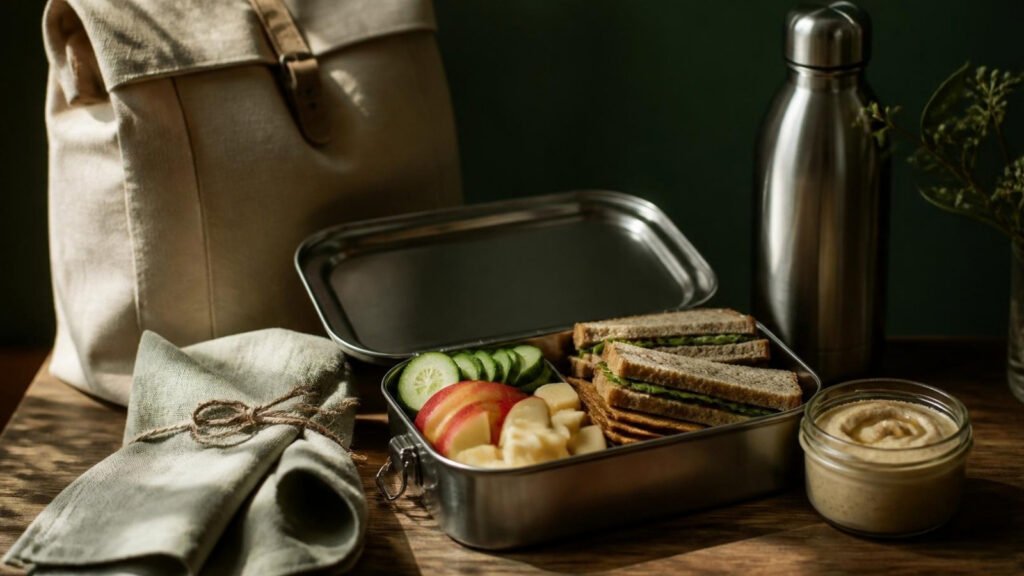
People frame bento as an aesthetic. It isn’t. It’s a packaging strategy, and the mechanism is simple: compartments replace wrapping.
Count what a conventional packed lunch actually consumes. A baggie for the sandwich. A baggie for the crackers. A baggie or a single-serve cup for the fruit. Maybe a square of foil, maybe a wrapper from a pre-portioned snack pack. That’s three to five disposable items per lunch, and none of them exist because the food needs them — they exist because the food needs to be kept apart from the other food.
A divided box solves the separation problem structurally. The grapes don’t need a bag because they have a wall. This is why bento cuts lunch waste far more than swapping one baggie for one reusable pouch: it removes the reason the packaging existed, rather than substituting a nicer version of it.
The secondary benefit is portioning. A five-compartment tray tells you, without any effort, that you’ve packed a protein, a fruit, a vegetable, a starch, and something small and good. I find that useful at 7 a.m. in a way I don’t find any app useful at 7 a.m.
Where I’ll Be Honest With You
A full stainless kit is a real upfront cost. Not a “small investment.” Somewhere around $75 to $105 in one go, in the same month you’re already buying shoes and a backpack and a graphing calculator. Anyone who tells you it’s cheap is selling something.
Glass may be banned at your school — and increasingly, so is metal. This surprised me and it’s the single most important thing to check before you spend money. Hardin County Schools in Kentucky banned both metal and glass water bottles effective August 6, 2026, permitting only plastic bottles with plastic lids. Districts in Ohio, New Jersey, and California have made similar moves. The stated reasons are safety and operations: bottles used as weapons in fights, opaque containers used to conceal contraband, noise and breakage. Whatever you think of the reasoning, the policy is the policy. Check your student handbook before you buy a stainless bottle, not after.
Stainless can’t be microwaved. If your kid’s school has a microwave they’re allowed to use, and they like hot lunches, a stainless bento is genuinely worse for that job than a plastic tray. The workaround is an insulated jar, which is a different purchase, not a free feature.
A full kit is heavy for a small kid. A loaded stainless bento, a full insulated jar, and a full water bottle is a meaningful load on a first-grader who’s also carrying books. I’m not going to pretend otherwise. For a younger child, pick two of the three and skip the rest.
And on insulated jars: the manufacturer numbers are best-case. Thermos states its FUNtainer food jar keeps food hot up to 5 hours. Independent testing with a calibrated thermometer has shown jars performing at that level — one tested jar held hot soup above 140°F even after six hours, and another had cooled to 135°F at the six-hour mark. But those tests used jars filled to capacity with boiling-hot liquid. A 10-ounce jar half-filled with lukewarm pasta and cracked open at snack time will not replicate them.
The honest version: a stainless kit is better for heat, better for lifespan, and roughly the same price as a good plastic one. It is not cheaper than a box of baggies, and it never will be.
The Plastic-Free Lunchbox Kit, Ranked
1. A stainless bento box
This is the anchor purchase and the one that eliminates the most disposables. Real current pricing: LunchBots stainless bentos run from about $21.99 for the small snack sizes to $41.49 for the Large Cinco, with the Medium Trio starting around $24.49 and the Medium Quad around $28.99. ECOlunchbox spans roughly $13 for a single small pod to $54 for their largest three-tier. PlanetBox Launch sets have been listing around $47.96 against a $64.40 regular price. LunchBots stainless containers have been repeatedly XRF-tested and reported lead-free, which is why I’m comfortable naming them.
Best for: Cold and room-temperature lunches — sandwiches, wraps, cut fruit, cheese, crackers. The everyday default.
2. An insulated food jar for hot lunches
This is the answer to the no-microwave problem, and it’s the item that lets you send leftovers. The Thermos FUNtainer 10 oz jar runs about $20.99 and is top-rack dishwasher safe. Preheat it — fill it with boiling water, cap it, wait five minutes, dump it, then add hot food. That step matters more than the brand does. The USDA’s instruction is equally unglamorous: keep the insulated container closed until lunchtime, and if you’re reheating leftovers to pack, take them to 165°F first.
Best for: Soup, chili, pasta, rice bowls, and any household that cooks dinner with lunch in mind.
3. A stainless water bottle — if your school allows one
Check the handbook first, per the honesty section above. If metal is permitted: the Thermos FUNtainer 12 oz kids bottle is about $16.99 and rated for 12 hours cold. Klean Kanteen’s single-wall 12 oz kids bottle is $17.95 and dishwasher safe but explicitly not insulated; their insulated 12 oz version is $25.95 and they recommend handwashing it. One brand note — Stanley has publicly confirmed that lead is used in the pellet sealing the vacuum base of its bottles, covered by a stainless barrier, with no recall issued. The exposure risk is low while that cover stays intact. I still wouldn’t put it in a kid’s daily kit when equivalent options exist.
Best for: Replacing juice boxes and single-use bottles, and doubling as a frozen cold source if you freeze it half-full overnight.
4. A cloth napkin and silicone dividers
The cheapest meaningful upgrade on this list. Silicone baking cups double as bento dividers, are dishwasher safe, and let you subdivide a two-compartment box into four without any wrapping. Sets vary wildly in price depending on where you buy and how many novelty food picks are bundled in — I’ve seen 24-packs around $20 and 70-piece kits marked up past $45 for essentially the same silicone. Buy the plain ones. The napkin doesn’t need to be bought at all; cut squares from a worn-out cotton shirt and hem them or don’t. Mine aren’t hemmed.
Best for: Killing off the last few baggies — the ones holding crackers, berries, and anything that would otherwise roll around.
5. An ice pack that isn’t a gel-filled plastic sleeve
Here’s the thing I like about this one: the best option is free. The USDA explicitly lists a frozen bottle of water as a valid cold source alongside gel packs, and it thaws into drinking water by lunch. Freeze two. That satisfies the two-cold-source guidance at zero cost. If you want something purpose-built, stainless-clad packs exist around $32.95 to $44.95 for a pair at roughly 5 x 3.5 inches, which clears the USDA’s 5×3 minimum — but read the fine print, because most of them are still gel on the inside with a steel shell. I’d rather be straight with you about that than let the word “stainless” do work it hasn’t earned.
Best for: Every single packed lunch, in pairs, no exceptions — this is the item people skimp on and shouldn’t.
Skip entirely: Pre-packaged snack pouches and single-serve cups, which are the most expensive calories in the store per ounce and generate a wrapper per item. Thin plastic bento trays sold as reusable with removable liners that warp after a semester. Novelty food picks. Disposable “compostable” sandwich wraps, which mostly require industrial composting your town probably doesn’t offer. And the free ice sleeve that came with the lunch bag — it’s almost always under the 5×3 minimum and it’s doing less than you think.
The Cost Math
I want to do this honestly, including the part that doesn’t flatter my argument.
Sandwich bags currently run about $4.19 for a 105-count box, roughly four cents a bag. Two bags a day across 180 school days is 360 bags — about $14 a year. That is the real number, and it is small. If someone tells you a reusable lunch kit pays for itself in a semester against baggies, the math doesn’t support it. An entry-level stainless kit — a Medium Trio around $24.49, a $20.99 food jar, a $16.99 bottle, plus dividers — lands around $75 to $85. Against baggies alone, break-even is somewhere in year five.
So here’s the comparison that actually holds up. A Bentgo Kids plastic bento is $29.99. A LunchBots Medium Quad is $28.99. They cost the same. The premium for stainless at the bento level is approximately zero — it’s a dollar in the other direction. Which means the whole “plastic is the budget option” framing collapses the moment you compare like to like.
The durability angle is where it compounds. A stainless box dents; it doesn’t crack, craze, warp in the dishwasher, or stain orange from tomato sauce, and it doesn’t degrade with heat cycling. I’ll be straight that I couldn’t find independent lifespan testing comparing plastic to stainless lunch containers — nobody seems to have run that study. What I have is the failure mode. Plastic trays fail at the hinges and the thin divider walls, and they fail on a schedule. Stainless mostly gets ugly and keeps working.
The correct summary: you are not saving money in year one. You are spending the same money on a box that outlives the school year instead of one that doesn’t.
Your 3-Step Fix
Don’t buy this in one transaction. An $85 cart in mid-August is how a plastic-free lunchbox plan dies before Labor Day. Build it across three weeks and let each piece prove itself.
Week one — buy the box, and read the handbook first. One stainless bento, sized to your kid rather than to the photo on the website. Before you order, confirm your school’s container policy on metal and glass, because that single check determines half your remaining purchases. Then use the box with the baggies you already own. Nothing else changes yet.
Week two — fix the cold chain. Freeze two water bottles the night before and start sending both, every day. This costs nothing, satisfies the USDA’s two-cold-source guidance, and is the step that most directly addresses the four-hour window. Add silicone dividers and a cloth napkin now and watch the baggie count go to zero on its own.
Week three — add heat only if you’ll use it. The insulated jar is the piece most likely to sit in a cabinet. Buy it in week three, once you know whether your kid will actually eat warm food at a cafeteria table. If two weeks of cold lunches went fine, keep the $20.99 and be done.
Frequently Asked Questions
Is stainless lunch gear actually dishwasher safe?
Mostly, with one consistent exception: insulated items. LunchBots bentos and PlanetBox trays are dishwasher safe, and Thermos FUNtainer jars and bottles are dishwasher safe on the top rack only. But Klean Kanteen recommends handwashing all insulated and painted styles, and that guidance is typical across brands — heat and detergent are hard on vacuum seals and exterior coatings. Uninsulated stainless, top rack, no thought required.
Will a stainless bento leak?
Plain stainless bentos with press-on lids are not leakproof, and you should assume they aren’t unless the product page says so explicitly with a gasket. Dressing, yogurt, and soup will find the seam. The practical fix is to keep wet things in a separate sealed dipper or a small silicone-gasketed container — most brands sell one for $13 or so — rather than expecting the main tray to contain liquid. Insulated jars, by contrast, seal properly.
How do I actually keep the food cold until noon?
Two cold sources, not one — that’s the USDA’s specific recommendation, with gel packs no smaller than 5×3 inches, or a gel pack paired with a frozen juice box or frozen bottle of water. Pack the lunch cold to start, use an insulated bag, and tell your kid to keep it in a locker or cubby rather than a sunny windowsill. Food needs to stay at or below 40°F; the two-hour room-temperature limit drops to one hour above 90°F.
Can my kid bring glass containers to school?
Often no, and this is worth checking rather than assuming. Many districts prohibit glass outright on breakage grounds, and a growing number now ban metal bottles as well — Hardin County Schools in Kentucky restricted both metal and glass water bottles effective August 6, 2026, allowing only plastic bottles with plastic lids, and districts in Ohio, New Jersey, and California have adopted comparable rules. Read your student handbook before buying. If your school is metal-restricted, keep the stainless bento for food and use whatever bottle they permit.
Is a stainless kit too heavy for a small child?
It can be. A full bento, a full insulated jar, and a full water bottle together is a real load for a five- or six-year-old also carrying a backpack. Scale down rather than opting out: choose a small or medium bento instead of a large, pick either the jar or the bottle rather than both, and let the school’s water fountain handle hydration if bottles are the heavy part. A kit the kid won’t carry is worse than a lighter kit they will.
Keep Reading
- Your Car Is a 130° Oven — the parent post to this one, on what heat actually does to plastic food containers and why a warm lunch bag is the same problem in miniature
- Zero-Waste Meal Prep — the prep system that fills the box, so packing five lunches doesn’t become five separate 7 a.m. decisions
- The Zero-Waste Freezer Blueprint — how to bank leftovers properly, which is what makes the insulated jar worth owning instead of worth storing
What’s the one lunch item in your house that keeps getting replaced — and have you found a version that finally lasted?
Want more clean kitchen content like this? Join the MZWK community — practical, no-BS guides for a healthier, lower-waste kitchen without the guilt trip.
Discover more from My Zero Waste Kitchen
Subscribe to get the latest posts sent to your email.