I was standing at the counter with a spent tea bag pinched between two fingers, about to drop it in the compost, when I noticed it would not tear. Paper tears. This thing stretched.
I held it up to the window. It was woven. A fine, glossy mesh, the same weave as a laundry bag, and I had just run near-boiling water through it and drunk the result.
If you have already dealt with the plastic containers, the cling film, and the water bottles, plastic in tea bags is the one that slips through. Tea is the thing you reach for because it feels clean. And the premium-looking pyramid sachet, the one that costs more than the flat paper bag, is the item in your cupboard most likely to be woven from a polymer.
Some links in this post are affiliate links. As an Amazon Associate I earn from qualifying purchases, at no extra cost to you.
What a “Silky” Pyramid Sachet Is Actually Woven From
There is no single answer, which is exactly the problem. Packaging suppliers today still list five common mesh materials for pyramid bags: nylon, PET (the same polymer as a soda bottle), PLA, Soilon (a corn-derived mesh), and non-woven synthetic fibre. A shopper standing in the tea aisle cannot tell any of them apart by looking.
Nylon and PET are the two that made this a story in the first place. They are petroleum plastics, and they are what the McGill researchers identified in the bags they tested in 2019.
PLA is the more common answer now, at least among brands that publish anything. Rishi states plainly that its sachets are made from plant-based PLA. Art of Tea says its pyramids are PLA and that it third-party tests to confirm there is no PET or nylon. Clipper uses a PLA bio-polymer to seal its bags and markets them as plastic free. PLA is plant-derived and industrially compostable, and it is genuinely a better material. It is also still a polymer mesh, with a glass transition temperature in the range of 45 to 65°C. Your kettle goes well past that.
The word to distrust is “silky.” It is a texture word wearing a material word’s clothes. It tells you how the bag feels and nothing about what it is.
The Steeping Numbers, and Why Temperature Is the Whole Story
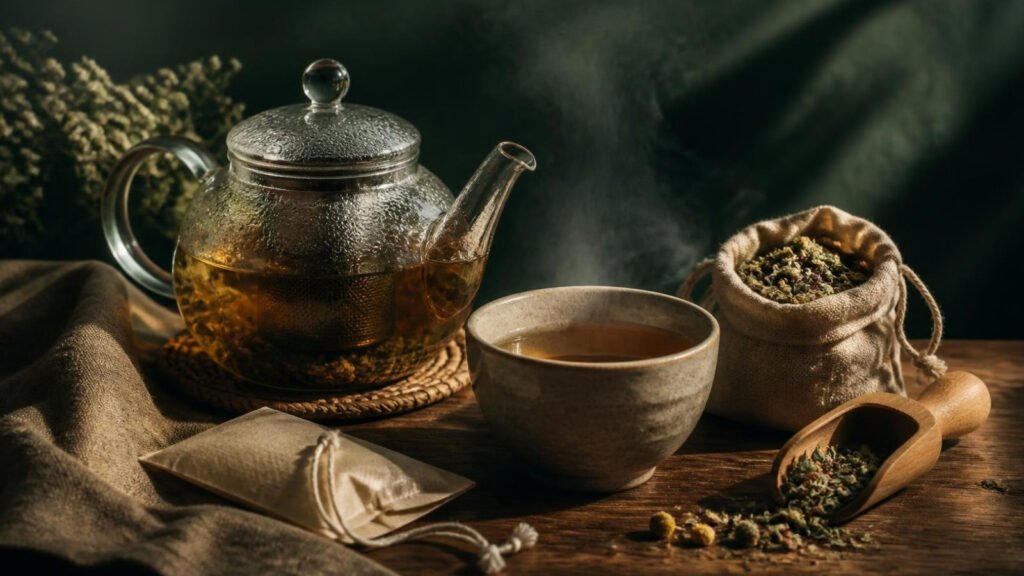
The study everyone quotes is Hernandez and colleagues at McGill University, published in Environmental Science & Technology in September 2019. They steeped a single plastic tea bag at 95°C and reported roughly 11.6 billion microplastic particles and 3.1 billion nanoplastic particles released into one cup. Spectroscopy matched the released material to the bags themselves: nylon and polyethylene terephthalate.
One method detail matters and is almost never mentioned: the researchers cut the bags open and removed the tea leaves first, so what they measured was an empty bag steeped in water, not an actual cup of tea.
A polymer mesh sitting in a box is inert. The same mesh at 95°C, agitated, for five minutes, is a different object.
A separate group at the Universitat Autònoma de Barcelona published in Chemosphere in 2024 and found particle release from three bag materials during brewing: polypropylene at roughly 1.2 billion particles per millilitre, cellulose at about 135 million per millilitre, and nylon-6 at 8.18 million per millilitre. They also exposed human intestinal cells to the particles and reported that mucus-producing cells took up the most, with some particles reaching the cell nucleus.
“Paper” Does Not Automatically Mean Plastic-Free
Here is the part that surprised me most. A flat paper tea bag has to be sealed shut somehow, and the traditional way to do it is to blend polypropylene fibres into the paper so the edges can be heat-sealed. Testing firm SGS wrote in 2020 that in some cases, excluding the tea, plastic accounts for roughly 25% of the teabag, and that 96% of teabags used in the UK at that time contained non-biodegradable polypropylene.
That 96% figure is six years old and UK-specific, and a lot has moved since. Clipper launched a plastic-free bag in 2018 and PG Tips went polypropylene-free around the same time. Treat it as history, not as a current market share.
The useful tell is the seal. A bag that is crimped, stapled, or knotted does not need a plastic heat seal. A bag with fused edges does, unless the brand has switched to a plant-based starch or PLA seal instead.
Three brands I could verify from their own current materials statements, which is the only kind of source worth using here:
- Traditional Medicinals — abacá fibre and FSC-certified wood pulp, described as fully compostable, non-heat sealed, and containing no plastics. Attached with a food-grade aluminium staple to a raw cotton string and paper tag. This is the box that lives on our counter, so I am relieved.
- Numi — abacá and softwood fibre, non-heat-sealed, closed with a crimp-and-knot process that they say eliminates the need for polypropylene entirely. BPI certified. Cotton string, recycled paper tag. Statement dated April 2026.
- Bigelow — their July 2026 breakdown says 90% of production uses non-heat-seal wood pulp and abaca with no adhesives, 10% uses a heat seal made from corn and sugarcane starches, and 0.2% is pyramid paper from the same plant starches. All stated to contain no plastic.
While we are in the kitchen: if there is a pod machine on the counter, Keurig states that all of its K-Cup pods are made from recyclable polypropylene, and hot water passes straight through that cup. Nespresso capsules are aluminium, which is a genuinely different material story.
Where I’ll Be Honest With You
The 11.6 billion figure is contested in the peer-reviewed literature, and almost nobody who repeats it mentions that.
In 2020, a group of German analytical chemists published a formal Comment on the McGill paper in the same journal. Their argument: the chemical analysis only confirmed synthetic polymer in 1.6 to 5.3% of the particles counted, and much of what was imaged was likely crystallised oligomers, which are soluble molecules and should not be counted as microplastics at all. Their own measurements found between 5,800 and 20,400 microplastic particles larger than 1 µm per bag. Thousands, not millions.
Germany’s Federal Institute for Risk Assessment reviewed the whole question in May 2025 and concluded that the count of particles larger than 1 µm is probably two to three orders of magnitude too high. They also said that based on current knowledge, it is unlikely that microplastic particles in food pose a health risk to humans.
EFSA’s food contact materials working group reached a similar methodological verdict in October 2025: current studies likely overestimate migration, largely because of drying artefacts in electron microscopy and a lack of validated protocols for counting nanoparticles. EFSA has not completed a risk assessment and says it cannot yet conclude on health effects. Its full scientific opinion is due at the end of 2027.
So, plainly: no study has shown that particles from tea bags harm humans. The toxicity work is in invertebrates and in cultured cells, and neither is a person drinking two cups a day for thirty years. The honest position is that we are ingesting something we did not consent to and do not yet understand, which is a reason to reduce exposure cheaply, not a reason to be frightened.
Two more things I will not paper over. Cellulose bags also shed particles in the Barcelona work, at about 135 million per millilitre, so switching to paper is not switching to zero. And I could not find a current, first-party statement from any major supermarket brand admitting to nylon or PET pyramid mesh today, even though suppliers clearly still sell it — so I am not naming names I cannot support.
The Swaps, Ranked
1. Loose Leaf Plus a Stainless Steel Basket Infuser
This removes the question entirely. Steel and water, nothing woven, nothing sealed. A deep basket that sits in the mug is the version people actually keep using, because the tiny ball-shaped infusers do not give the leaves room to open and the tea tastes thin. Buy one good basket rather than three cheap ones.
Best for: Daily drinkers who want the biggest reduction in exposure and the lowest cost per cup over a year.
2. A Non-Heat-Sealed Paper Bag From a Brand That Publishes Its Materials
Convenience matters, and a bag you will actually use beats an infuser you will not. The rule I use: the brand has to state the fibre and the sealing method in writing on its own site. Traditional Medicinals, Numi, and Bigelow all do. If a brand’s website only says “natural materials,” that is a non-answer.
Best for: Mornings when you have four minutes, and for anyone who will not tolerate a strainer to wash.
3. A Teapot or French Press With a Built-In Strainer
If you brew more than one cup at a sitting, this is less fuss than an infuser, not more. A French press you already own for coffee works fine for herbal blends and large-leaf teas. Rinse it well first unless you enjoy chamomile that tastes faintly of espresso.
Best for: Households brewing two or more cups at once, or anyone already using a press.
4. Ground Coffee and a Reusable Filter Instead of Pods
The same logic applies one appliance over. Keurig’s own site confirms K-Cup pods are polypropylene, and hot water is forced through that cup under pressure. A refillable steel pod, or simply a pour-over cone, sidesteps it. Nespresso’s aluminium capsules are a different case and I would not rank them as urgent.
Best for: The coffee drinker in the house who has been quietly ignoring this whole article.
Skip entirely: Any pyramid sachet where the brand will not state the mesh material in writing, and any product whose only description of the bag is that it is “silky.” Not because those bags are proven harmful, but because a company that will not tell you what a thing is made of has told you something anyway.
The Cost Math
I priced this from brand websites in August 2026, and I used the same brand on both sides where I could, so it is a fair comparison rather than a flattering one. Loose leaf figures assume 2.5 grams per cup.
- Rishi PLA sachets: $10.00 for 15, which is about 67 cents a cup.
- Rishi loose leaf, same brand: China Breakfast at $50.00 a pound works out to roughly 181 cups, or about 28 cents a cup. The quarter-pound tin at $17.50 lands nearer 39 cents.
- Traditional Medicinals bagged: $7.49 for 16 bags, about 47 cents a cup.
- Bigelow bagged: $21.95 for 120 bags, about 18 cents a cup.
The honest conclusion: loose leaf comfortably beats premium sachets, roughly halving the per-cup cost. It does not beat bulk supermarket tea bags. If someone tells you switching to loose leaf will save you money, that is only true if you were buying the fancy pyramids to begin with. A good steel basket infuser runs about $29 from the manufacturer, which pays for itself in about 74 cups if you are coming off sachets, and never pays for itself if you are coming off cheap bags. Buy it for the material, not the maths.
Your 3-Step Fix
Step 1: Do the stretch test tonight. Take a used, cooled bag and pull it gently at the corner. Paper tears and goes limp. Mesh stretches and springs back. This takes four seconds and tells you more than the front of the box does.
Step 2: Check the brand’s own site, not a listicle. Search the brand name plus “what are your tea bags made of.” Several brands reformulated in the last few years, so a 2021 blog post ranking them is worse than useless. If the brand has no statement, send one email and see whether you get a material name or a mood.
Step 3: Change one thing, not everything. Buy a single basket infuser and one bag of the loose leaf version of the tea you already drink most. Finish the boxes you own. Nothing here justifies throwing away food you already paid for.
Frequently Asked Questions
Can I tell if a tea bag has plastic just by touching it?
Partly. A woven mesh that stretches rather than tears is a polymer of some kind, though that could be nylon, PET, or plant-based PLA, and touch will not distinguish them. A flat paper bag with fused, welded-looking edges has some kind of heat seal, which may or may not be plastic. The test narrows things down; only the manufacturer can confirm.
Are pyramid sachets always plastic?
No. Bigelow says its small pyramid line uses plant-based starches, and several specialty brands use PLA mesh. But packaging suppliers still openly sell nylon and PET pyramid mesh, so the shape guarantees nothing either way. The pyramid is a brewing decision, not a materials one.
Does the string, tag, or staple matter?
Much less than the bag, because they mostly sit outside the water. Traditional Medicinals uses a food-grade aluminium staple, raw cotton string, and a paper tag; Numi uses cotton string and a recycled paper tag. Worth knowing for composting, not worth losing sleep over for steeping.
Can I compost plastic-free tea bags at home?
Genuinely plastic-free paper bags, yes, staple removed if you are fussy. PLA is a different animal: it is described as compostable in commercial systems, which run hotter than a backyard pile. Rishi and Art of Tea both specify commercial composting. In a home bin, expect it to persist.
Should I actually be worried about the health effects?
Not worried, no. The German BfR concluded in 2025 that microplastics in food are unlikely to pose a human health risk on current knowledge, and EFSA says it cannot yet conclude either way, with a full opinion due at the end of 2027. Nobody has demonstrated harm to people from tea bag particles. This is a low-cost swap made under uncertainty, which is a different thing from a warning.
Keep Reading
- Your Car Is a 130° Oven — why temperature, not time, is the variable that moves particles out of plastic and into food
- How to Spot Greenwashing in Your Kitchen — how words like “silky,” “natural,” and “plant-based” do work that material names would not
- The Clean Pantry Reset — where loose leaf actually lives once you switch, so it does not go stale in a paper pouch
Do the stretch test on whatever is in your cupboard right now, and tell me what you found. Which brand surprised you?
Want more clean kitchen content like this? Join the MZWK community — practical, no-BS guides for a healthier, lower-waste kitchen without the guilt trip.
Discover more from My Zero Waste Kitchen
Subscribe to get the latest posts sent to your email.