My father-in-law swears by his grill mats. Last summer I watched him peel one off the grates at the end of a cookout and a corner came away in flakes — little grey-black curls of coating stuck to the burgers he had just served. He shrugged and threw it out. Bought a new one the next week. I could not stop thinking about the flakes.
If you have already thrown out your nonstick pans, I have bad news about the thing sitting on your grill.
Some links in this post are affiliate links. As an Amazon Associate I earn from qualifying purchases, at no extra cost to you.
Your Grill Mat Is a Nonstick Pan
Not “like” a nonstick pan. It is one.
The standard grill mat is fiberglass cloth coated in polytetrafluoroethylene — PTFE, the exact compound that makes Teflon slick. Manufacturers say so openly in their own product copy. It is the same chemistry we covered in the cookware guide, sold in a different aisle, where nobody thinks to look for it.
And it is marketed with the same sleight of hand: “100% PFOA-free.” PFOA was the processing chemical phased out years ago. Saying a mat is PFOA-free tells you nothing about the PTFE coating you are actually cooking on. It is the identical trick the cookware industry ran, and it works just as well the second time.
The Number Nobody Does the Math On
Here is where it stops being a philosophical objection and starts being arithmetic.
Grill mats are rated to a maximum of 500°F. Several manufacturers go further and specify that if you use the mat for more than 30 minutes, the ceiling drops to 260°F.
Now the other number. PTFE begins releasing fumes at 500°F. That is the documented threshold where the polymer starts breaking down. Pyrolysis — full thermal decomposition — begins around 752°F, and above roughly 930°F the breakdown products include hydrogen fluoride and carbonyl fluoride, the fluorine cousin of phosgene.
Read those two paragraphs again. The mat’s maximum safe rating is the exact temperature at which its coating begins to degrade. There is no safety margin built in. The ceiling is the failure point.
And now the third number, which is the one that ends the argument. High heat on a grill runs 450°F to 650°F. Searing a steak calls for 450–550°F. Grillers who measure grate temperature with an infrared thermometer routinely read 500°F to 1,000°F at the bars.
So the honest summary: a product rated to 500°F, made from a coating that starts failing at 500°F, is being sold specifically for a cooking method that normally runs hotter than 500°F.
The mat is not being misused when it degrades. It is being used exactly as intended, on equipment that is hotter than it was ever designed for.
Overheated PTFE causes polymer fume fever — chills, headache, chest tightness, a dry cough, symptoms that get mistaken for a summer bug. It is well documented and it usually passes in a day or two. It is also, and this is not an exaggeration, frequently fatal to pet birds. If you keep birds and grill on a covered patio, that alone is reason enough to stop.
Where I’ll Be Honest With You
I came into this post expecting to also nail aluminum foil to the wall. The research would not let me.
Aluminum does migrate from foil into food, and the rate climbs with acidity, salt, spices, temperature, and contact time — a lemon-and-tomato marinated fish in a foil packet is close to the worst case you could design. But when researchers modeled a high-exposure scenario, the additional intake worked out to roughly 4.4% of the tolerable weekly intake set by European food safety authorities. That is a real contribution. It is not a crisis.
The caveat worth keeping: background dietary aluminum for most adults already sits near or above that weekly guideline before foil enters the picture. So the sensible rule is not “never touch foil.” It is keep foil away from acidic and heavily salted food at high heat — no citrus-marinated packets, no tomato-sauced anything. For a plain foil-wrapped potato, the evidence does not support panic.
Same discipline on lighter fluid. There is plenty of confident writing online about petroleum residue on your food, and I could not find research solid enough to repeat it here. The case for a chimney starter is that it lights faster, costs nothing to run, and does not make your food taste like a gas station. That is a good enough reason without inventing a health claim.
The mat is the real problem. The rest is housekeeping.
What to Grill On Instead
1. Bare Grates — The Free Answer
Most people reach for a mat because food sticks, and food sticks because the grates were dirty or cold. Preheat properly, scrape, then oil the grate with a folded towel and tongs right before the food goes on. This solves the problem the mat was invented for, at no cost, with no coating.
Best for: Steaks, burgers, chops, chicken thighs. Anything sturdy. Start here before buying anything.
2. Stainless Grill Basket — The Actual Mat Replacement
This is what the mat was standing in for: keeping small things from falling through. A perforated stainless basket does it better, will not degrade at any temperature a grill produces, and lasts for years instead of a season. Get 304 stainless.
Best for: Chopped vegetables, shrimp, sliced onions, anything small. The one purchase that actually replaces the mat.
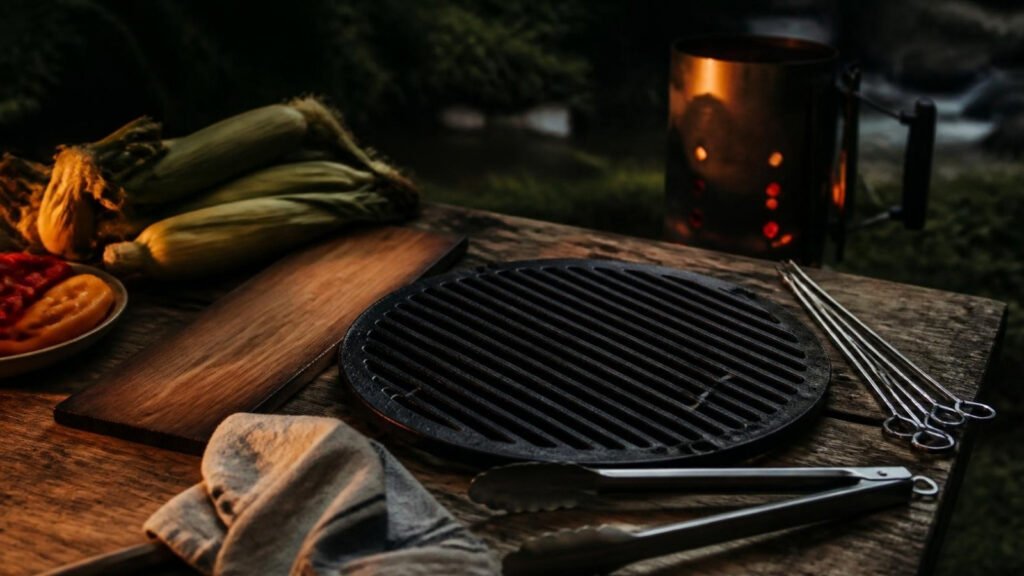
3. Cast Iron Griddle or Grate Topper — The Heat Sink
For fish, eggs, smash burgers, anything genuinely delicate. Seasoned cast iron gives you a real nonstick surface built from polymerized oil rather than fluoropolymer, and it improves with age. It is heavy and it needs drying after washing. That is the whole downside.
Best for: Fish, delicate items, smash burgers. Buy once, keep forever.
4. Cedar or Alder Planks — The Flavor Play
Soak, set on the grate, cook on top. The plank is a barrier and a flavor source at once, and it is the single best way to grill salmon without losing half of it to the grates. Untreated cooking planks only — never construction lumber.
Best for: Salmon and other fish. Single-use, but it is wood, and it composts.
Skip entirely: PTFE-coated mats regardless of the PFOA-free label, nonstick-coated grill toppers and baskets, and any accessory advertising a “nonstick coating” without naming the material. If the packaging will not say what the coating is, that is the answer.
The Cost Math
Grill mats are cheap and that is the entire appeal. A two-pack runs about ten dollars. But they scratch, flake, and get replaced — my father-in-law is on roughly two a season, which is a recurring cost forever.
A stainless grill basket is a one-time purchase in the twenty to thirty dollar range. A cast iron griddle or grate topper runs thirty to fifty and will outlive the grill it is sitting on — quite possibly the house. Cedar planks are a few dollars each and only come out for fish.
Call it under fifty dollars to be done with this permanently. The mats cross that number in about three seasons and you own nothing at the end of it.
Your 3-Step Cookout Fix
Step 1: Throw out any mat that is scratched, flaking, or discolored — today. A degraded coating is not a maintenance issue to monitor. Once it is shedding, it is shedding into food. This is the only step with any urgency.
Step 2: Learn the preheat-scrape-oil sequence. Hot grill, clean grate, oil applied to the bars immediately before the food. Do this properly for two cookouts and you will discover you never needed a mat. It is the cheapest fix in this entire post.
Step 3: Buy one stainless basket. Not a whole kit. The basket covers the small-food problem that sends most people to mats in the first place, and you can add cast iron later if you actually miss it.
And while you are at it: stop marinating in foil packets with citrus or tomato. Glass or stainless for the marinade, then straight onto the grate.
Frequently Asked Questions
My grill mat says PFOA-free. Isn’t that the safe kind?
PFOA was a processing aid phased out of production years ago, so essentially everything on the market is PFOA-free. The claim says nothing about the PTFE coating itself, which is the part in contact with your food and the part that degrades at 500°F.
What if I only grill on low heat?
Then you are inside the rating, and that is genuinely lower risk. The practical problem is that grate temperature varies enormously across a grill surface and a lid thermometer sits six to ten inches above the food, reading a different number entirely. You would need an infrared thermometer on the bars to actually know.
Is silicone a safer mat option?
Food-grade silicone is more chemically stable than PTFE within its rated range, but most silicone products are not rated for direct grill heat, and grill surfaces routinely exceed what they can handle. For grilling specifically, stainless or cast iron is the better answer.
I’ve used mats for years. Should I be worried?
Polymer fume fever is acute and self-limiting rather than cumulative, so there is no dose you have been quietly banking. Stop using degraded mats, switch to a stable material, and move on. That is the whole action item.
Do I need to replace my grill grates too?
Almost certainly not. Standard grates are bare cast iron, porcelain-enameled cast iron, or stainless — none of which have a fluoropolymer coating. The mat was the problem, not the grill.
Keep Reading
If this one landed, these go deeper on the same thread:
- Is Your Cookware Slowly Poisoning You? A Guide to PFAS-Free Pots and Pans — The indoor half of this exact problem.
- The Real Cost of ‘Eco-Friendly’ Products: How to Spot Greenwashing in Your Kitchen — Why “PFOA-free” works on so many of us.
- Your Car Is a 130° Oven — And Your Groceries Are Sitting In It — Getting the food home before it ever reaches the grill.
Is there a grill mat in your garage right now? Go look at it — really look, in decent light. If the surface is scratched or dulled, that is your answer. Tell me in the comments what shape yours is in. I am curious how many of us have been quietly serving flakes.
Want more clean kitchen content like this? Join the MZWK community — practical, no-BS guides for a healthier, lower-waste kitchen without the guilt trip.
Written by Dan Duda
Dan builds software for a living and spends the rest of his time rethinking how his kitchen cooks, stores and shops. He started My Zero Waste Kitchen to share the sourced, practical swaps he actually uses, and to keep plastics and harsh chemicals out of the food he makes. More about Dan
Discover more from My Zero Waste Kitchen
Subscribe to get the latest posts sent to your email.