Every November in mid-Missouri, the same thing happens around 4:30 on Thanksgiving afternoon. The turkey is resting, the rolls are going cold, and someone is hunched over the roasting pan, whisking flour into a puddle of drippings and hoping it doesn’t turn to lumps. Meanwhile, the little paper packet of giblets that came inside the bird is already in the trash.
Those two problems have the same fix. The parts most people throw away are exactly what make the best gravy, and you can deal with them now, while the kitchen is calm.
The waste adds up. In a November 2025 analysis, ReFED estimated that 320 million pounds of food would be thrown away on Thanksgiving, worth about $550 million, and that 40% of it is turkey. Gravy is one of the easiest places to start cutting that: the neck, the giblets and a few weeks of onion skins and carrot peels become a rich stock, and the stock becomes gravy in about 15 minutes on the day. Here’s how to make ahead turkey gravy from the parts most people toss, what the food safety guidance actually says about storing it, and the one shortcut I’d skip.
Some links in this post are affiliate links. As an Amazon Associate I earn from qualifying purchases, at no extra cost to you.
Freeze the Stock, Not the Gravy
Most make-ahead gravy advice tells you to cook the whole batch weeks early and freeze it. I do it the other way around, and so does the food preservation research. In a University of Georgia report on freezing holiday leftovers, Elizabeth Andress, who led the National Center for Home Food Preservation, explained that gravy tends to separate and curdle when thawed, and said it’s better to freeze broth and make gravy just before serving.
That splits the job into two parts:
- Now (the slow part): roast turkey wings or necks with saved vegetable scraps, simmer them into a deep, gelatin-rich stock, strain it, and freeze it in jars.
- Thanksgiving (the fast part): thaw the stock in the fridge, cook fat and flour into a roux, whisk in the stock, and finish with the bird’s own giblets and drippings.
The ratio I build from is the turkey gravy recipe on USDA’s MyPlate Kitchen, from Oregon State University Extension: 2 tablespoons of fat (butter or turkey drippings), 3 tablespoons of flour and ¼ teaspoon of salt for every 1½ cups of low-sodium broth, cooked over low heat for 5 to 10 minutes after the broth goes in, with about ½ cup of cooked, chopped giblets stirred in at the end. Scale it by the batch: four times that is ½ cup of fat, ¾ cup of flour, 1 teaspoon of salt and 6 cups of stock.
The Make-Ahead Stock, Step by Step
This is my method, not a tested lab recipe, so adjust to your pot and your scraps. The food safety numbers in it come from USDA and FoodSafety.gov.
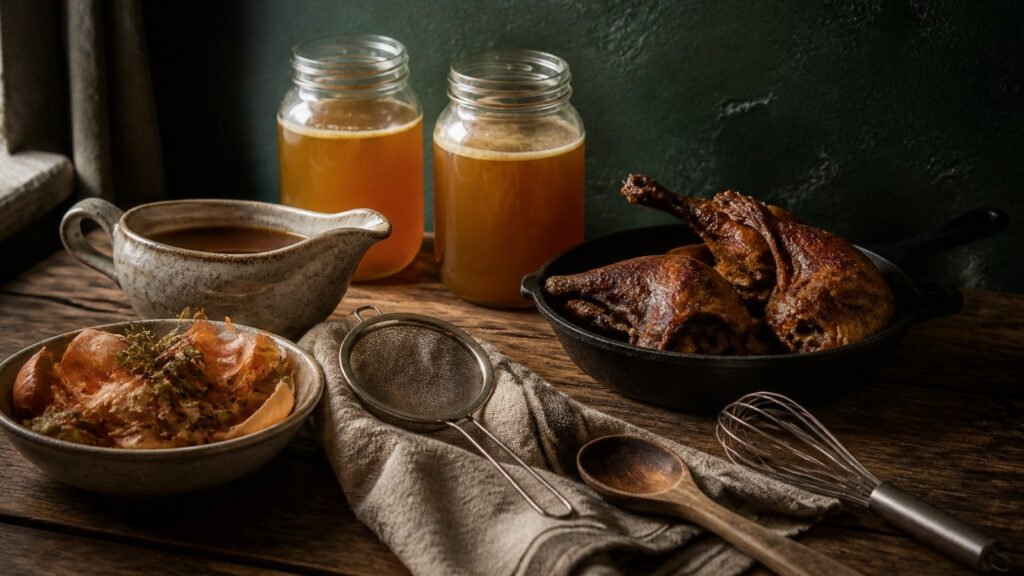
- Start a scrap jar today. Onion ends and skins, carrot peels, celery leaves and parsley stems go into a jar in the freezer as you cook. Two or three weeks of everyday cooking fills one. More ideas are in my root-to-stem recipes.
- Buy two or three pounds of turkey wings or necks. Raw poultry pieces keep 1 to 2 days in the refrigerator, according to FoodSafety.gov, so make the stock within a day or two of buying them, or freeze them until you’re ready.
- Roast for color. I roast the pieces in a cast iron skillet or sheet pan at a high oven temperature until they’re deep brown. Color is flavor here; pale bones make pale gravy.
- Simmer low and long. Move the roasted pieces and the scrap jar to a stainless stock pot, cover with cold water, and pour a splash of water into the hot roasting pan to scrape up the browned bits into the pot. Keep it at a bare simmer for three to four hours, skimming foam now and then. A hard boil makes cloudy, greasy stock.
- Strain and cool fast. Pour through a stainless fine-mesh strainer. FSIS says to divide large amounts of food into shallow containers so they cool faster, and that hot food can go directly into the refrigerator. Don’t leave the pot on the stove overnight.
- Save the fat. Once the stock is cold, the fat sets in a layer on top. Lift it off and keep it: that’s the fat for your roux on Thanksgiving, so nothing is wasted and you don’t need extra butter.
- Freeze in jars with headspace. I use wide-mouth pint jars, because one jar holds the stock for a 1½-cup batch of gravy with room to spare. Liquids expand as they freeze, so leave room at the top: Penn State Extension’s liquid-pack headspace guidance is ½ inch in a wide-mouth pint and 1 inch in a wide-mouth quart. The bones and spent scraps go to the trash or a municipal compost program; I keep cooked bones out of our backyard bin.
Where I’ll Be Honest With You
Gravy advice is confident and often contradictory. Here’s where the evidence is thinner than the headlines.
- Frozen gravy isn’t unsafe, it’s just unreliable. The separating and curdling Andress describes is a texture problem. FSIS lists cooked poultry dishes, stuffing and gravy at 4 to 6 months in the freezer for quality. If you freeze finished gravy anyway, Andress suggests thickening it with waxy rice flour or waxy corn flour, and stirring while reheating helps keep it smooth.
- Agencies don’t agree on how long gravy keeps in the fridge. FSIS gives 3 to 4 days for cooked dishes and gravy. The Minnesota Department of Health’s turkey guidance says to use gravy within 1 to 2 days. I go with the shorter number, which is another reason I freeze stock and make gravy on the day.
- You don’t need drippings for good gravy. A dark stock carries most of the flavor. Drippings add depth on the day, but if your turkey is smoked, fried or cooked somewhere else, the stock and saved fat can make the whole batch.
- The giblet packet is safe to use, but it has rules. FSIS says to remove the giblets from the turkey’s cavities after thawing and cook them separately. FoodSafety.gov lists giblets with all poultry at a safe minimum internal temperature of 165°F. I simmer the neck, heart and gizzard while the turkey roasts and chop them for the gravy. I leave the liver out of a long simmer because I find it muddies the flavor; that’s taste, not a safety rule.
- I couldn’t find a federal storage time for raw giblets specifically. I treat them like other raw poultry pieces: 1 to 2 days in the fridge, per FoodSafety.gov.
Ways to Make Gravy Ahead, Ranked
Ranked by how well the gravy holds up and how little goes to waste.
1. Frozen Stock, Fresh Roux on the Day
Move the jars from the freezer to the fridge two days before Thanksgiving; FSIS lists the refrigerator as a safe way to thaw. On the day, melt the saved fat (or drippings) over low heat, whisk in the flour and salt until bubbly, then slowly add the stock while whisking constantly with a flat whisk, which gets into the corners of a pan. Cook 5 to 10 minutes, add the chopped cooked giblets and a spoonful of drippings from the turkey, and taste for salt.
Best for: Anyone hosting, anyone who has ever made lumpy gravy under pressure, and kitchens with one oven and too many dishes.
2. Finished Gravy, Made One or Two Days Ahead
Make the full gravy on Tuesday or Wednesday, cool it in shallow containers and refrigerate. That stays inside both the FSIS window and the stricter Minnesota guidance. FSIS says to reheat gravy by bringing it to a rolling boil, and it will thicken in the fridge, so whisk in a splash of stock as it heats.
Best for: Cooks who want zero stovetop work on Thursday and are fine giving up the fresh drippings.
3. Frozen Finished Gravy, Thickened With Waxy Rice Flour
If you really want the whole thing done weeks out, follow Andress’s suggestion and use waxy rice flour (sold as sweet or glutinous rice flour) instead of wheat flour, freeze it in jars with headspace, thaw it in the fridge, and stir steadily as it comes to a rolling boil. Expect to whisk in some stock to bring it back together.
Best for: People cooking for a crowd who want a backup batch in the freezer, and anyone who already keeps a gluten-free flour around.
4. Same-Day Giblet Stock While the Turkey Roasts
No time before the holiday? Put the neck, heart and gizzard in a saucepan with water and a handful of scraps as soon as the bird goes in the oven, and simmer for the two or three hours it roasts. It’s thinner than a roasted-wing stock, but it’s free, and it uses the packet everyone else throws away.
Best for: Last-minute planners and small households roasting a breast or a small bird.
Skip entirely: Roasting the turkey with the giblet packet still inside (FSIS says to remove it and cook giblets separately), cooling a full stockpot on the stove overnight, leaving the gravy boat on the table all afternoon (FSIS says to discard turkey, stuffing and gravy left out longer than 2 hours), and throwing out the neck and giblets because nobody knows what they’re for.
The Cost Math
I won’t quote prices, because broth, butter and turkey parts swing every year and from store to store. The math is about what you stop buying. Scaled from the MyPlate ratio, 6 cups of gravy takes 6 cups of stock, ½ cup of fat and ¾ cup of flour. Made this way, the stock comes from vegetable scraps you were going to throw out, a neck and giblets that came with the turkey, and a few pounds of wings, and the fat is skimmed off that same stock. What drops off the shopping list is the boxed broth and the stick or two of butter, plus the gravy packets some households keep as backup.
Leftover gravy has value too. FSIS gives turkey covered with broth or gravy a 6-month freezer window versus 4 months for plain turkey, so a ladle of extra gravy over frozen leftover portions is worth keeping, not scraping into the trash.
Your 3-Step Fix
- This week, start a scrap jar in the freezer. Onion skins, carrot peels and celery leaves go in every time you cook.
- By the weekend before Thanksgiving, make and freeze the stock. Roast wings or necks, simmer with the scraps, strain, chill, save the fat, and freeze in pint jars with ½ inch of headspace.
- Two days out, move it to the fridge; on the day, make the roux. Fat, flour, stock, then the cooked giblets and a spoonful of drippings. Refrigerate leftovers within 2 hours.
Frequently Asked Questions
How far ahead can you make turkey gravy?
Finished gravy can be refrigerated for a day or two; FSIS allows 3 to 4 days, and the Minnesota Department of Health says 1 to 2. For anything longer, freeze the stock and make the gravy on the day, or freeze finished gravy and expect to whisk it back together.
Can you freeze turkey gravy?
Yes. FSIS lists gravy at 4 to 6 months in the freezer for best quality. The National Center for Home Food Preservation’s Elizabeth Andress notes that gravy tends to separate and curdle when thawed, and suggests waxy rice or waxy corn flour as the thickener plus stirring while you reheat.
What do I do with the giblets in my turkey?
FSIS says to remove them from the cavity after thawing and cook them separately. Simmer the neck, heart and gizzard into a quick stock while the turkey roasts, then chop the cooked meat into the gravy. Giblets, like all poultry, should reach 165°F.
How do I reheat make-ahead gravy safely?
FSIS says to reheat sauces, soups and gravies by bringing them to a rolling boil. Thaw frozen gravy or stock in the refrigerator, cold water or the microwave, which FSIS lists as the safe thawing methods for leftovers.
Can I make gravy without drippings?
Yes. The MyPlate Kitchen recipe works with butter or drippings, and a well-browned stock carries most of the flavor. Using the fat skimmed from your own chilled stock gets you closest to a drippings gravy without the bird.
Keep Reading
- Bone Broth to Veggie Scraps: 5 Root-to-Stem Recipes
- The Zero Waste Freezer Blueprint
- How to Season Cast Iron and Bring Any Pan Back
Do you keep the giblets, or does the packet go straight in the trash? Tell me in the comments what your family does with the neck and giblets, and whether you’ve ever frozen finished gravy and had it hold together.
Want more clean kitchen content like this? Join the MZWK community: a new practical guide every Sunday, without the guilt trip.
Written by Dan Duda
Dan builds software for a living and spends the rest of his time rethinking how his kitchen cooks, stores and shops. He started My Zero Waste Kitchen to share the sourced, practical swaps he actually uses, and to keep plastics and harsh chemicals out of the food he makes. More about Dan
Free printable: get the 7-Day Kitchen Reset Kit, a daily checklist, a week-long waste audit, fridge labels and a use-it-up planner, plus a new guide every Sunday.
Discover more from My Zero Waste Kitchen
Subscribe to get the latest posts sent to your email.