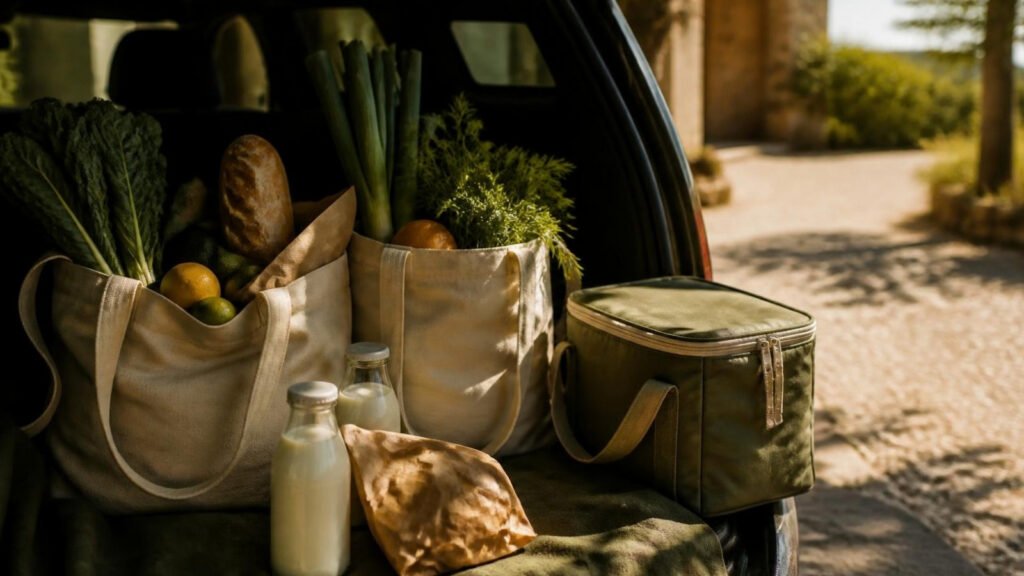
Last July I came out of the store, loaded four bags into the back of the RAV4, then remembered I still had one more stop. Forty minutes later I opened the hatch and the smell hit me — that warm, faintly chemical plastic smell coming off a shrink-wrapped tray of chicken and a case of water bottles. I stood there in the parking lot doing math I did not want to do.
If you have spent money on organic produce, pasture-raised eggs, and clean pantry staples — and then driven them home in a car that turned into an oven — this post is about the gap in between. It is the least-discussed part of a clean kitchen, and in July it is the part that matters most.
Some links in this post are affiliate links. As an Amazon Associate I earn from qualifying purchases, at no extra cost to you.
The Number That Reframes Everything
Research from San Jose State University’s meteorology department found that a car parked in direct sun heats about 19°F in the first 10 minutes, and sits 43°F to 47°F above the outside air after an hour.
Run that on a normal Missouri July afternoon. It is 92° outside. You are in the store for 45 minutes. Your car is now roughly 130 to 135°F. Your dashboard, where a lot of people set a drink or a bag, is far worse — dark dash surfaces regularly measure 157°F to over 200°F.
Here is why that specific range matters: 40 to 70°C (roughly 104 to 158°F) is precisely where chemical migration out of plastic accelerates. Below it, migration from decent-quality plastic is minimal. Inside it, the chemistry changes. Your car is not a little warm. It is sitting in the exact window where plastic stops being inert and starts being an ingredient.
What’s Actually Moving Out of the Plastic
Three things, and they are not the same problem.
Microplastics and nanoplastics
A University of Nebraska–Lincoln study published in Environmental Science & Technology tested plastic food containers under real usage conditions. Microwaving for three minutes released as many as 4.22 million microplastic and 2.11 billion nanoplastic particles per square centimeter of container surface. Microwave heat produced the highest release of any scenario tested.
The uncomfortable follow-up: the same study found refrigeration and room-temperature storage over six months also released millions to billions of particles. Heat is the accelerant, not the only cause.
Phthalates
These are the softeners that make plastic flexible. They are endocrine disruptors, and the FDA currently authorizes eight ortho-phthalates as plasticizers in food-contact materials. The agency opened a post-market safety review of them this spring, with the public comment window closing June 26 of this year. Translation: they are under review, they are not banned, and they are in your kitchen right now.
Antimony and bisphenols from PET bottles
PET is the #1 plastic your bottled water comes in. Antimony leaching from PET accelerates meaningfully above about 40°C. A University of Florida study held bottled water at 158°F for four weeks and measured antimony concentrations up to 319 times higher than refrigerated controls.
Where I’ll Be Honest With You
That 319-fold number sounds terrifying, and it deserves context, because I would rather you trust me than scare you.
In that same study, only one of sixteen brands actually exceeded the EPA limit, and that was after four straight weeks at 158°F — a harsher condition than one hot afternoon. The study’s own co-author said plainly that bottled water is fine to drink; just do not store it hot.
Same story on health outcomes. Microplastics have now been found in blood, placenta, arterial plaque, and brain tissue. One study found people with plastic detectable in their arterial plaque had roughly 4.5 times the risk of heart attack, stroke, or death over three years. That is a real, alarming correlation — and it is still a correlation. A 2026 evidence review concluded that no definitive causal link between microplastic uptake and a specific human health outcome has been proven yet.
So: this is not a five-alarm emergency. It is a slow, cumulative, entirely avoidable exposure. And the fixes cost almost nothing, which is what makes ignoring them irrational.
The 4 Materials That Don’t Care How Hot It Gets
1. Glass — The Default
Wide-mouth mason jars, Pyrex, borosilicate storage. Glass does not leach, does not stain, does not hold onto garlic smell, and goes from fridge to oven. Half-gallon and quart jars run roughly $2–4 each, which makes this the cheapest upgrade in your entire kitchen. The trade-off is obvious: it breaks, and it is heavy for a lunch bag.
Best for: Leftovers, prepped produce, anything acidic, anything you’ll reheat. The one to buy first.
2. Stainless Steel — The Travel Answer
18/8 or 304 stainless containers and bottles. No leaching at any temperature, which is the entire point in July. This is what should be in your car, your cooler, and your kid’s lunch bag. Expect roughly $15–35 for a good container set, more for insulated. It cannot go in the microwave, and you cannot see what is inside.
Best for: Car, cooler, lunches, camping. The heat-proof workhorse.
3. Platinum-Cured Silicone — The Useful Exception
Silicone is more heat-stable than plastic and is genuinely good for freezer bags, lids, and baking mats. But “silicone” on a label is doing a lot of work — cheap fillers are common. Look explicitly for platinum-cured or food-grade LFGB-rated, and do the pinch test: twist a corner, and if white shows through, there are fillers in it.
Best for: Freezer storage, reusable bags, lids. Verify the grade or skip it.
4. Beeswax Wraps & Cloth — The Small Stuff
Not a heat solution, but the right replacement for cling film on cheese, cut produce, and bowl covers. Keep them out of the car and away from anything warm, because they melt.
Best for: Fridge and counter. Not for heat.
Skip in heat, no exceptions: #1 PET (bottles), #3 PVC, #6 polystyrene (takeout clamshells), and #7 “other.” And treat “BPA-free” as marketing until proven otherwise — the common replacements, BPS and BPF, are structurally similar and behave similarly. It is the same trick the cookware industry ran with “PFOA-free.”
The Cost Math
This is where it gets almost silly.
A 12-pack of quart mason jars runs about $20 and lasts until you drop one. A decent stainless container set is a one-time $25–35. An insulated cooler bag you keep permanently in the trunk is $20–30. Call the whole summer fix under $80, once.
Compare that to what most households already spend: $6–10 a week on bottled water, plus replacing warped, stained, cloudy plastic containers every year or two. The clean version is cheaper by year two, and it does not degrade.
You are also already paying a premium for good food. Buying organic produce and then hauling it home at 130°F wrapped in polystyrene is spending money on the front half of a system and undoing it on the back half.
Your 3-Step Summer Fix
Step 1: Put a cooler bag in your car and leave it there. Not for camping — for every grocery trip, permanently. This single habit solves cold-chain safety and heat-leaching in one move, and it costs you nothing after the first purchase. Cold food last into the cart, first into the bag.
Step 2: Decant when you get home, not when you eat. Takeout, deli containers, prepped produce — into glass within a few minutes of walking in. The plastic-to-food contact time is the variable you control, and it costs about ninety seconds.
Step 3: Never reheat in the container it came in. Not the takeout clamshell, not the deli tub, not the “microwave-safe” one. Microwave-safe means the container will not warp. It says nothing about what moves into your food. Plate it, then heat it.
And the small one worth adding: stop keeping a case of water bottles in your trunk. That is the single hottest, longest-duration plastic exposure most households have, and a stainless bottle ends it.
Frequently Asked Questions
Is “microwave-safe” plastic actually safe?
It means the container will not melt or warp at microwave temperatures. It is a structural rating, not a chemical migration rating. The Nebraska study tested FDA-approved polypropylene containers, and microwave heating still produced the highest particle release of any scenario tested.
I left water bottles in a hot car. Should I throw them out?
Dump the water and recycle the bottle — do not refill it. One afternoon is not a medical event, and the research does not support panic. But PET is designed for single use, and heat plus reuse is the worst combination for it.
Is BPA-free plastic safe in heat?
Treat it as unproven. BPA got replaced largely by BPS and BPF, which are structurally similar and show similar behavior in testing. If heat is involved, the answer is glass or stainless, not a different plastic.
Does freezing plastic cause leaching too?
Less than heat, but the Nebraska study found that cold and room-temperature storage over six months still released significant particle counts. Time matters alongside temperature. Long-term storage is a good argument for glass and stainless regardless of season.
What about silicone — is it really better?
Platinum-cured, food-grade silicone is meaningfully more heat-stable than plastic and is a legitimate upgrade for freezer bags and lids. Unlabeled cheap silicone often contains fillers. Buy the grade, not the word.
Keep Reading
If this one landed, these go deeper on the same thread:
- Is Your Cookware Slowly Poisoning You? A Guide to PFAS-Free Pots and Pans — The “PFOA-free” label trick, and what to actually cook on.
- Wood Cutting Board vs Plastic: Why We Finally Made the Switch — The other everyday plastic that quietly ends up in your food.
- Spring Meal Prep Without the Plastic — The weekly system, built on glass and stainless you probably already own.
What’s currently living in your trunk? Drop a comment — I want to know if I’m the only one who did the parking-lot math. And if you’ve got a case of water bottles back there, no judgment. Start with the cooler bag. That’s the whole first step.
Want more clean kitchen content like this? Join the MZWK community — practical, no-BS guides for a healthier, lower-waste kitchen without the guilt trip.
Discover more from My Zero Waste Kitchen
Subscribe to get the latest posts sent to your email.