Every October I spread newspaper across the kitchen table, set a big bowl in the middle, and start scooping. By the time the lid is off and the walls are scraped, the bowl is heaped with slippery orange strings and pale seeds, and my hands smell like a squash patch after rain.
For years that bowl went straight to the trash can. Now it is the start of three different things I cook that week, and the only part of the pumpkin that leaves my kitchen is the tough outer skin, headed for the compost pile at the edge of my Missouri garden.
If you have ever stood over that bowl wondering what to do with pumpkin guts, you are standing at the exact point where most of the waste happens. The scale is real. The USDA Economic Research Service reports that U.S. farms produced 1.44 billion pounds of pumpkins in 2024, and that about 85 percent of pumpkin acreage (per the 2022 Census of Agriculture) goes to the fresh and ornamental market, not to canned puree. Most of those pumpkins are bought to look at. When they hit a landfill, they join the rest of our wasted food: the EPA notes that roughly 31 percent of the U.S. food supply is wasted each year, and that landfills account for 18 percent of U.S. methane emissions. A pumpkin is one of the easiest foods to keep out of that stream.
Some links in this post are affiliate links. As an Amazon Associate I earn from qualifying purchases, at no extra cost to you.
What to Do With Pumpkin Guts: Know Your Pumpkin First
Think of a pumpkin as four ingredients: seeds, guts (the stringy pulp around the seeds), flesh, and skin. Which pumpkin you have decides how many you can use.
The big difference is between carving pumpkins and pie pumpkins. University of Illinois Extension describes processing pumpkins, sometimes called pie or sweet pumpkins, as having high sugar content, more flavor, less water, and smooth-textured flesh, and notes they are generally smaller and less grainy than jack-o-lantern types. For baking, Illinois Extension suggests choosing smaller pumpkins, ideally in the 4 to 8 pound range. Purdue Extension puts the carving side plainly: jack-o-lantern pumpkins are usually larger, with stringier pulp and more watery flesh.
The seeds and guts do not care much which pumpkin they came from. Purdue Extension notes that seeds from any pumpkin can be dried and roasted, and the guts carry flavor into stock regardless of variety. So the plan changes by pumpkin: from a carving pumpkin, save the seeds and guts before carving and compost the rest after Halloween. From a pie pumpkin, use everything but the skin.
The best time to rescue a jack-o-lantern is the hour you carve it, not the week after Halloween.
Timing is the other half. The seeds and guts are fresh food on carving night. Two weeks later, the same pumpkin on a porch is a compost ingredient, and nothing more.
Where I’ll Be Honest With You
Carving pumpkins are edible, but they are not great eating. Purdue Extension says fresh, uncarved jack-o-lantern pumpkins can be cooked with fairly good results, but sugar or pie pumpkins are the better choice. In my kitchen, carving-pumpkin puree comes out pale and watery and needs hours of draining. If you want pie, buy a pie pumpkin.
Do not eat a carved pumpkin that has been sitting out. This is the one zero-waste instinct I will talk you out of. Purdue Extension’s answer to whether you can eat your jack-o-lantern is yes, as long as it is in good condition and has not yet been carved. Purdue food and nutrition specialist Bill Evers explained the reason years ago: like melons, pumpkins are low in acid, so there is a possibility of food poisoning if the pumpkin has been sitting around with even a nick in it. A carved pumpkin has exposed flesh and days at room temperature. That one goes to compost.
Home canning pumpkin puree or pumpkin butter is not recommended. The National Center for Home Food Preservation (NCHFP) has a tested pressure-canning process for pumpkin, but only for 1-inch cubes, with the explicit caution “do not mash or puree.” Their FAQ explains why: there was too much variation in viscosity among batches of pumpkin puree to calculate a single safe processing time, and pumpkin is a low-acid food that can support Clostridium botulinum. Pumpkin butter has the same problem; NCHFP says its safety depends on thickness, acidity, and water activity together, and no tested home process exists. Their recommendation is to freeze puree or keep pumpkin butter in the refrigerator for short-term use. Plenty of blogs show canned puree anyway. That does not make it safe.
Leaving pumpkins in the woods “for wildlife” is not the nature win it looks like. Wildlife agencies are consistent here. The Illinois Department of Natural Resources, as quoted by Illinois Extension, does not recommend feeding pumpkins to wildlife because of damage complaints and disease spread, including chronic wasting disease (CWD) in deer. Colorado Parks and Wildlife warns that pumpkins draw bears, and predators following deer, into neighborhoods. Here in Missouri, the Department of Conservation explains that feeding deer artificially congregates them and increases disease transmission, and it prohibits consumable deer attractants in counties within 10 miles of a CWD detection. A rotting pile in the woods is not composting. It is feeding, and Illinois Extension notes it can count as littering.
About that famous landfill number. You will see “1.3 billion pounds of pumpkins in landfills every year” everywhere. I could not trace it to a primary source I could check, so I am not using it. The USDA production figures make the point on their own.
Every Part of the Pumpkin, Ranked
These are ranked by how much value they get out of a pumpkin for the effort, starting with the one I would never skip.
1. Roast the Seeds
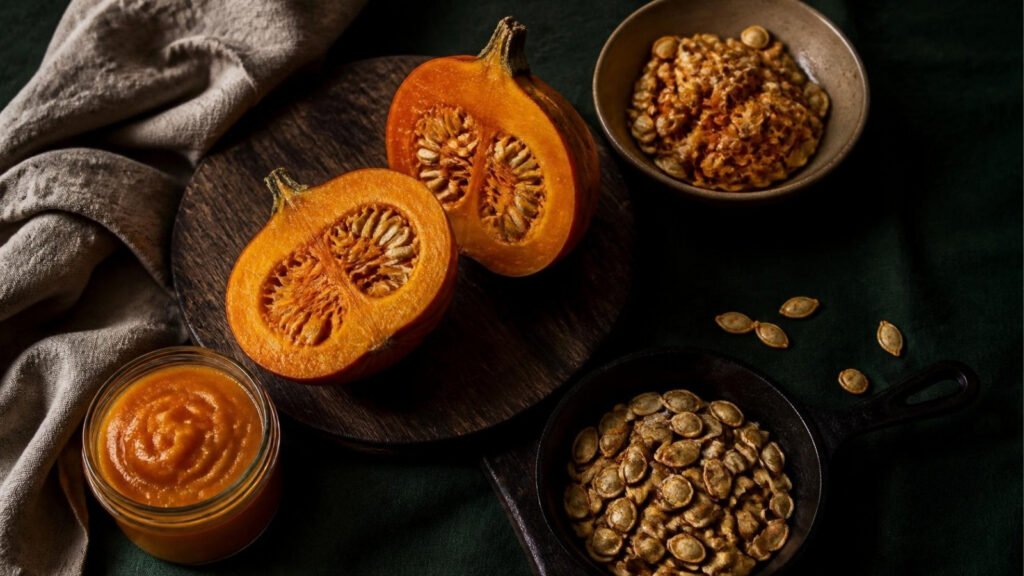
Seeds are the easiest win and work from any pumpkin, carving or pie. Oregon State University Extension’s method: wash the seeds carefully to remove the clinging fiber, then dry them (in a dehydrator at 115 to 120°F until crisp, or in the oven at 150°F for 1 to 2 hours, stirring often). Toss with a little melted butter or oil and salt, then roast in a shallow pan: about an hour at 250°F, 30 minutes at 275°F, or 10 to 15 minutes at 300°F. My rule of thumb: drop the seeds in a bowl of water first, since most seeds float and most strings sink. OSU notes seeds turn rancid at room temperature over time, so for longer storage I keep mine in a glass jar in the refrigerator or freezer.
Best for: Every pumpkin you cut open, including jack-o-lanterns on carving night. Snacking, salads, soup toppings, and granola.
2. Roast and Puree the Flesh of Pie Pumpkins
This is where a pie pumpkin earns its price. NCHFP’s instructions for freezing pumpkin say to wash it, cut it into cooking-size sections, remove the seeds, and cook until soft in boiling water, steam, a pressure cooker, or the oven, then remove the pulp from the rind and mash. I prefer the oven: halved, cut-side down on a sheet pan at 400°F until a fork slides through the skin easily. Roasting drives off water and deepens flavor. Scoop, blend, and it is ready for pie, muffins, soup, or oatmeal.
Best for: Sugar or pie pumpkins bought for cooking, and fresh, uncarved carving pumpkins if you are willing to drain the puree.
3. Freeze the Puree in Glass
Since canning puree is off the table, the freezer is the right home for it. NCHFP says to cool cooked pumpkin quickly by setting the pan in cold water and stirring occasionally, then package it with half an inch of headspace, seal, and freeze. NCHFP’s general headspace table calls for more room for purees in narrow-mouth jars and in quarts, so I use wide-mouth glass pints with half an inch. I portion in one- or two-cup amounts and chill the jars completely in the refrigerator before they go into the freezer.
Best for: Anyone who roasted more pumpkin than they can use in a week, and anyone who wants to skip the can aisle through winter.
4. Simmer the Guts Into Stock
This is my answer when people ask me what to do with pumpkin guts after the seeds are out. The stringy pulp has a surprising amount of flavor. I put the strings in a pot with saved vegetable scraps (onion ends, carrot peels, celery tops), cover with water, simmer about 45 minutes, and strain. The result is a light, slightly sweet stock that makes a good base for squash soup and risotto. This is personal practice, not a tested preservation recipe: I refrigerate it for a few days or freeze it in glass with headspace, and I only use guts scooped that same day.
Best for: Carving night, when you have a big bowl of fresh strings and no plan for them. Soup people.
5. Blend the Guts Into Baking Puree
If you do not want stock, blend the strings smooth for quick breads, muffins, and pancakes. The texture is looser and the flavor milder than flesh puree, so I swap it in for part of the puree or liquid, not all of it. I cook it before freezing it in glass with headspace. This is my kitchen practice, for fresh guts from a just-cut pumpkin only.
Best for: Bakers, and households carving several pumpkins at once who would rather not make a vat of stock.
6. Compost the Skin and the Jack-o-Lantern
The tough outer skin and the whole carved jack-o-lantern after Halloween belong in compost. Illinois Extension calls pumpkins ideal for composting and recommends removing all decorations, paint, and anything non-compostable first. That means candle wax, glitter, and marker. I chop the shell into chunks so it breaks down faster and bury it in the middle of the pile, where it draws fewer animals. No pile? Look for a community pumpkin smash or drop-off; Illinois Extension describes these as partnerships with local waste haulers that compost the pumpkins afterward. Many cities also run yard waste or compost programs that take pumpkins. Mid-Missouri has had its own pumpkin smash outside a local farmers market, complete with a trebuchet, so check with your city’s solid waste or compost program in late October.
Best for: Skins, carved jack-o-lanterns, and any pumpkin that has gone soft or moldy on the porch.
Skip entirely: Eating or cooking a carved pumpkin that has sat out, canning pumpkin puree or pumpkin butter at home, and hauling old pumpkins into the woods or a ditch for wildlife.
The Cost Math
A pumpkin will not save you hundreds of dollars. The savings are real but modest and depend on local prices, so treat this as a labeled estimate to redo with your own numbers.
A standard 15-ounce can of pumpkin is a little under two cups. In my kitchen, a 4 to 6 pound pie pumpkin usually yields roughly two to three cans’ worth of puree, though yield varies. If a pie pumpkin costs about the same as two cans where you shop, you break even on the flesh and come out ahead on everything else. Roasted pumpkin seeds sell at a premium by the ounce; one pumpkin gives you a snack-sized batch for a little oil and salt. The guts, as stock, replace a carton of vegetable broth. None of it is a fortune, but the pumpkin is already bought, and every part you use is money already spent working for you instead of going to the curb.
Your 3-Step Fix
- Set out two bowls on carving night. One for seeds, one for guts. Roast the seeds and make stock or puree from the guts right away.
- Buy one pie pumpkin for the kitchen. Carve the big one, cook the small one. Roast it, puree it, and freeze it in wide-mouth glass jars with half an inch of headspace.
- Plan the jack-o-lantern’s exit before November 1. Strip the candle and decorations, then compost it at home or at a pumpkin smash or city program. Not the woods.
Frequently Asked Questions
What can I do with pumpkin guts besides throwing them away?
Separate out the seeds for roasting, then simmer the stringy pulp with vegetable scraps into a light stock, or blend it smooth and use it as a partial substitute for puree in muffins and quick breads. Anything left over goes to compost. Use guts only from a freshly cut pumpkin.
Can I eat my jack-o-lantern after Halloween?
No. Purdue Extension says a jack-o-lantern pumpkin is fine to eat only if it is in good condition and has not been carved. Pumpkins are low in acid, and a carved one that has been sitting out with exposed flesh is a food safety risk. Save the seeds and guts on carving night instead, and compost the shell afterward.
Can I can homemade pumpkin puree or pumpkin butter?
Not safely at home, according to the National Center for Home Food Preservation. The only tested process is for pressure-canning 1-inch cubes, and NCHFP specifically says not to mash or puree before canning. Freeze puree instead, and keep pumpkin butter in the refrigerator for short-term use.
Is it good to leave old pumpkins out for deer and other wildlife?
Wildlife agencies say no. The Missouri Department of Conservation notes that feeding deer congregates them and raises disease risk, including chronic wasting disease, and Illinois and Colorado officials give similar warnings. Compost it instead.
Do I need a pie pumpkin to roast pumpkin seeds?
No. Purdue Extension notes that seeds from any pumpkin can be dried and roasted, so your carving pumpkin’s seeds are just as usable. Seed size varies, so I give big seeds a few extra minutes if they are not crisp yet.
Keep Reading
- How to Freeze Zucchini Without Plastic — the same glass-jar freezing method I use for pumpkin puree.
- Root-to-Stem Recipes for Kitchen Waste — more scrap stocks and broths to pair with your pumpkin-gut stock.
- Build a DIY Zero-Waste Compost Bin — a home for the skin and the jack-o-lantern come November.
What is your go-to seasoning for roasted pumpkin seeds: plain salt, something sweet, or something with heat? Tell me in the comments, and if you have ever turned pumpkin guts into something good, I want to hear about that too.
Want more clean kitchen content like this? Join the MZWK community — practical, no-BS guides for a healthier, lower-waste kitchen without the guilt trip.
Discover more from My Zero Waste Kitchen
Subscribe to get the latest posts sent to your email.