I’m back. And honestly? The zero-waste world didn’t exactly wait for me.
If you’ve felt like sustainability news has been a constant stream of “new rules,” “new programs,” and “new confusing labels”… you’re not wrong. The good news: a lot of what’s happening makes zero waste kitchen habits easier, not harder, because the world is (slowly) building better systems around the habits many of us have already been practicing at home.
Here are the zero waste kitchen trends I’m watching for 2026, and what they mean for your kitchen this week, not “someday.”
1) Composting is becoming the default (not the niche)
For years, composting felt like an optional “if you’re extra” habit. That’s changing.
What’s happening
- New York City has required residents to separate food waste and yard trimmings from other trash since October 2024. The Department of Sanitation began issuing fines on April 1, 2025, then scaled enforcement back to focus on larger buildings that had ignored repeated warnings, according to a report shared by the New York City Council.
- California’s SB 1383 requires local jurisdictions to provide organic waste collection to all residents and businesses, and requires residents to sort their organic waste into the correct containers, according to CalRecycle.
What it means for your kitchen
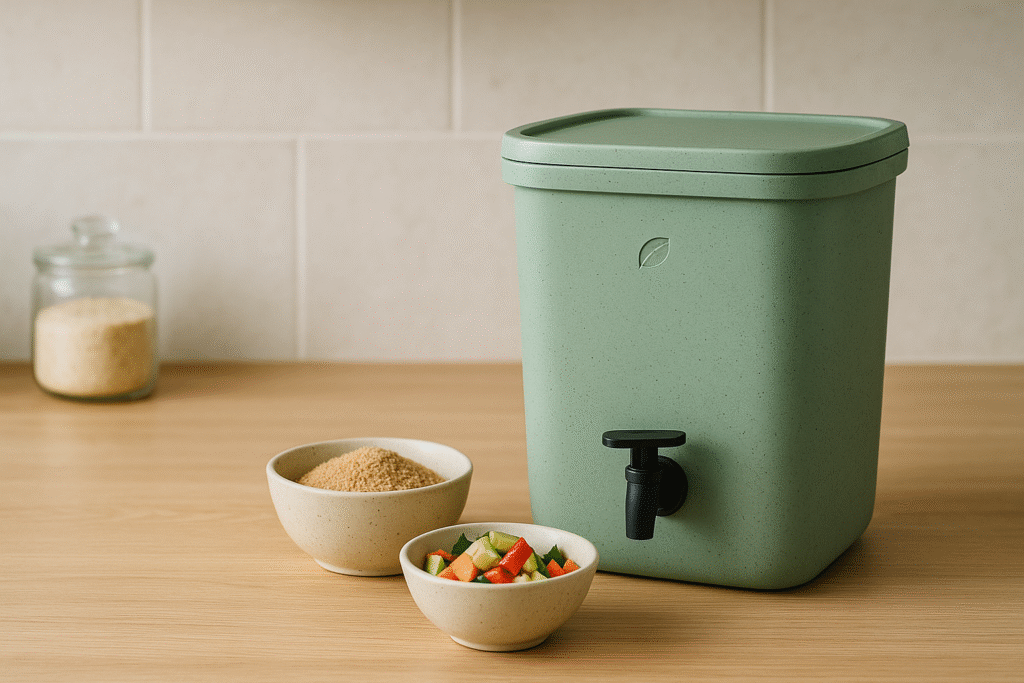
Composting is shifting from “nice idea” to expected infrastructure. When cities normalize separation, it gets easier for everyone: better pickup, better education, and more places that actually accept what you’re sorting. No city program where you live? Bokashi composting works in a small kitchen, and a DIY compost bin works if you have a yard.
Do this this week (10 minutes)
Pick one:
- Put a small container in your freezer labeled “stock scraps” (onion ends, carrot peels, celery tops) and another labeled “compost-only” (coffee grounds, eggshells, banana peels).
- If you already compost: add one friction-reducer (a counter caddy, a lid, a simple rinse-and-dry routine for the bin).
2) Food-waste laws are targeting the real problem: confusion
A sneaky driver of food waste is simple: unclear date labels.
What’s happening
- California’s AB 660 standardizes date labels. Starting July 1, 2026, covered foods (eggs and infant formula are exempt) must use “BEST if Used by” or “BEST if Used or Frozen by” for quality, and “USE by” or “USE by or Freeze by” for safety, and consumer-facing “sell by” dates are banned, according to the California Department of Food and Agriculture. Coded “sell by” dates that help stores rotate stock are still allowed.
What it means for your kitchen
The direction is clear: systems are starting to treat edible food as valuable, and to treat “date confusion” as a fixable design problem. Even outside California, a simple rule helps: “best if used by” is about quality, “use by” is about safety.
Do this this week (5 minutes)
Upgrade your fridge language:
- EAT FIRST (next 48 hours)
- FREEZE OR PLAN (this week)
This is low effort and weirdly powerful. In my kitchen, most of what gets wasted is food that got pushed behind other food and forgotten.
3) Reuse and refill are moving beyond boutique shops
Remember when refill stations felt like a niche thing you had to hunt down? Reuse is increasingly showing up in policy, not just in specialty stores.
What’s happening
- Packaging laws are starting to name reuse and refill as goals outright. The EU regulation in the next section is the biggest example.
- Where refill and return options exist locally, they’re easier to build into a routine than they used to be.
What it means for your kitchen
Reuse is becoming a system, not a personal virtue test. When stores and brands build return infrastructure, “being low-waste” stops requiring constant willpower.
Do this this week (choose one swap)
- If you buy seltzer or soda: try one returnable or deposit option, if your area has one.
- If you buy dish soap or hand soap: shift one item to a refill format (local refill shop, concentrates, or bulk where it exists).
4) Packaging rules are getting real (and they’ll influence what shows up on shelves)
Even if you’re in the U.S., what Europe does affects global brands and packaging design.
What’s happening
- The EU’s Packaging and Packaging Waste Regulation (Regulation (EU) 2025/40) entered into force on February 11, 2025, and generally applies from August 12, 2026, according to the European Circular Economy Stakeholder Platform. It covers all packaging and packaging waste regardless of material, aims to prevent unnecessary packaging and promote reuse, refill, and recycling, and phases in recyclability performance grades from 2030.
What it means for your kitchen
Expect more packaging experiments from global brands: reduced materials, redesigned formats, and more reuse pilots. For more on spotting the marketing side of that shift, see our greenwashing guide.
5) The plastics conversation keeps shifting toward rules
My read: voluntary pledges haven’t moved fast enough on their own, and more of the conversation is about regulation than it used to be.
What it means for your kitchen
This reinforces the smartest household strategy:
- Don’t rely on “recyclable” packaging as the win
- Prioritize refill, reuse, and food waste prevention: the habits you control directly
The “Back on Track” 7-Day Zero-Waste Kitchen Reset
If you haven’t practiced in a while, here’s the no-guilt reset that actually sticks.
Day 1: Inventory + plan one “use-it-up” meal
Stir-fry, soup, sheet pan, or pasta: anything that tolerates randomness. Root-to-stem recipes are a good place to start.
Day 2: Start a “scrap system”
One freezer container for stock scraps; one bin for compost. The Zero-Waste Freezer Blueprint walks through the freezer side.
Day 3: Fix your fridge visibility
Add EAT FIRST and FREEZE OR PLAN zones.
Day 4: Choose one refill or bulk habit
Soap, oats, rice, coffee: just one. Our pantry reset shows how to store bulk goods.
Day 5: Swap one disposable
Paper towels → cloths. Zip bags → one reusable container you actually like. More ideas in our nine clean kitchen swaps.
Day 6: Learn one local rule
What’s accepted in compost? What’s accepted in recycling? Don’t guess; confirm once.
Day 7: Make it easy
Move the tools where you use them: caddy near the prep area, jars where you portion, labels where you decide.
My take: zero waste is becoming “default behavior”
Not because everyone suddenly became perfectly eco-conscious, but because infrastructure, laws, and retail models are slowly catching up to what works.
And the more the system improves, the more your kitchen habits compound.
Download: The 7-Day Kitchen Reset Kit (Printable)
Want to actually do the reset? The free 7-Day Kitchen Reset Kit puts the daily checklist above on one page, adds a 7-day waste audit that shows where your food really goes, and includes cut-out EAT FIRST and FREEZE OR PLAN fridge labels, a freezer scrap map and a use-it-up meal planner. No email required.
Download the 7-Day Kitchen Reset Kit (PDF)
Want more clean kitchen content like this? Join the MZWK community: a new practical guide every Sunday, without the guilt trip.
Written by Dan Duda
Dan builds software for a living and spends the rest of his time rethinking how his kitchen cooks, stores and shops. He started My Zero Waste Kitchen to share the sourced, practical swaps he actually uses, and to keep plastics and harsh chemicals out of the food he makes. More about Dan
Free printable: get the 7-Day Kitchen Reset Kit, a daily checklist, a week-long waste audit, fridge labels and a use-it-up planner, plus a new guide every Sunday.
Discover more from My Zero Waste Kitchen
Subscribe to get the latest posts sent to your email.