The butternuts came in the second week of October, the way they usually do here, a wheelbarrow of tan bottles with stems still green at the cut. I lined them up on the back porch in the afternoon sun and thought about how many squash, in past winters, I’ve carried to the compost pile in February with soft gray spots on their bellies.
I don’t have a root cellar. I have a normal house in Missouri with a furnace, a fridge, a spare room, and a garage that gets very cold in January. This year I stopped guessing and matched each crop to the spot that suits it.
Here’s why it matters. The USDA estimates that food waste in the United States runs between 30 and 40 percent of the food supply, which it put at roughly 133 billion pounds and $161 billion worth of food in its 2010 baseline. A squash that rots in the pantry is some of the most avoidable waste there is. Learning how to store winter squash, and the potatoes, onions, and roots that come in next to it, is mostly a matter of knowing four numbers and finding the right corner.
Some links in this post are affiliate links. As an Amazon Associate I earn from qualifying purchases, at no extra cost to you.
Why a Root Cellar Isn’t the Point
A root cellar is just a place that is cold and humid at once. The problem is that the fall harvest does not agree with itself. University of Missouri Extension’s root cellar guide lists winter squash and pumpkins at 50 to 55°F with 60 to 75 percent relative humidity, while carrots and beets want 32 to 40°F with 90 to 95 percent humidity. Sweet potatoes want it warm and moist, and MU Extension is blunt about it: do not let them drop below 50°F. No single room serves all of them.
So the goal is to sort your harvest into groups (warm and dry, cold and dry, cold and moist) and match each group to a spot you already have.
The other piece is curing, a short warm rest after harvest. For winter squash, Iowa State University Extension recommends curing at 80 to 85°F and 80 to 85 percent relative humidity to harden the skin and heal small wounds. Illinois Extension describes a gentler version, holding squash at room temperature (about 70°F) for 10 to 20 days. Sweet potatoes need curing even more. Penn State Extension’s guidance is 80 to 85°F at 85 to 95 percent humidity for 4 to 7 days, stretching to 10 days for roots with a lot of skinned patches. Potatoes cure cooler. Penn State says 2 to 3 weeks at 50 to 60°F with 85 to 90 percent humidity, and University of Minnesota Extension says to brush off dried soil but not to wash them.
Acorn squash is the exception: skip the warm cure, because it makes acorns keep worse, not better.
That exception catches a lot of people. Iowa State Extension states that the high temperature and humidity of curing actually reduce the quality and storage life of acorn squash. Illinois Extension lists acorn, sweet dumpling, and delicata as types that don’t benefit from curing. Wipe them off and move them straight to storage.
The Quick Temperature and Humidity Reference
These are the storage targets I work from, with the source for each.
- Winter squash and pumpkins: 50 to 55°F, 50 to 75% humidity (MU and Illinois Extension). Cool and dry, never cold.
- Sweet potatoes: 55 to 60°F, 85 to 90% humidity after curing (Penn State). Never below 50°F.
- Potatoes: 40 to 46°F, about 90% humidity, in the dark (Penn State). Avoid going below 38°F, which causes sugar buildup.
- Onions and garlic: 32 to 40°F, 65 to 70% humidity, with good air flow (Iowa State). Cold and dry.
- Apples: 32 to 40°F, 80 to 90% humidity (MU Extension). Keep them away from everything else.
- Carrots and beets: 32 to 35°F, 95% humidity or higher, with tops trimmed to about half an inch to an inch (Iowa State). Cold and moist.
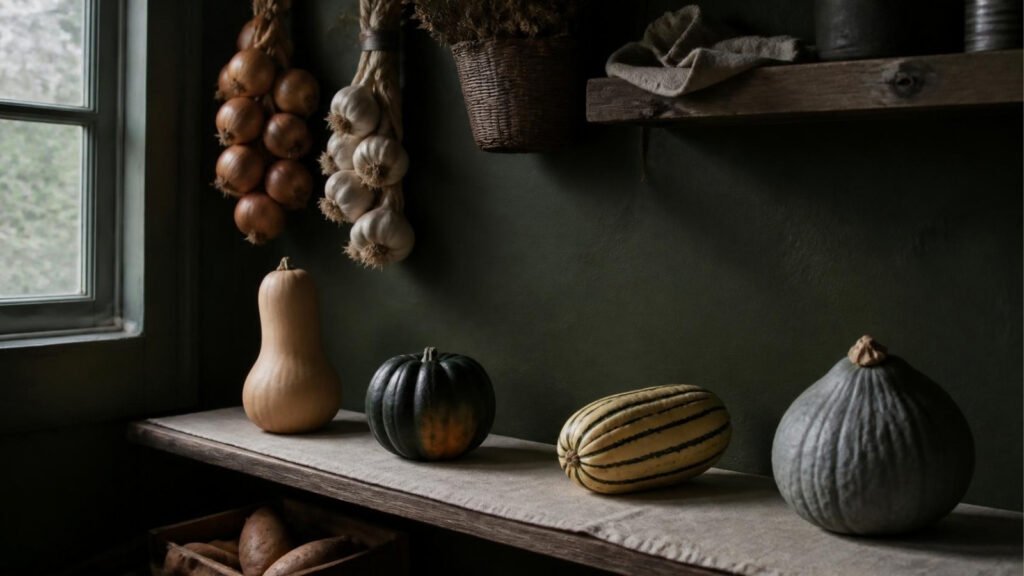
On keeping time, the squash varieties are very different. Iowa State Extension gives acorn about 5 to 8 weeks, butternut 2 to 3 months, and hubbard 5 to 6 months. Illinois Extension’s numbers are close: acorn up to two months, butternut up to three, hubbard up to six. The University of Minnesota’s commercial postharvest table puts buttercup at about 3 months and kuri at 4 to 5 months. Eat acorns and delicatas first, and save hubbards and butternuts for late winter.
Where I’ll Be Honest With You
That “keeps for six months” figure you see everywhere is real, but it describes ideal conditions. Illinois Extension says large hard-rind squash can keep up to six months “under these conditions,” meaning 45 to 50°F, dry, and not touching each other. The University of Minnesota’s six-month hubbard figure comes from a commercial table that specifies 51°F and 50 percent humidity. A heated house in winter usually runs warmer than that, even in the spare room. Squash still keeps there, but I plan on the short end of every range, and I check them weekly.
Here is the common advice that fails in a normal house:
- Sealed plastic bags. University of Minnesota Extension warns that unperforated plastic bags often create too much humidity, which leads to condensation and mold. If you use a bag in the fridge for carrots, poke holes in it. Cornell Cooperative Extension suggests 1/4- to 3/8-inch holes for ventilation.
- Washing before storage. UMN Extension says to brush dried soil off potatoes but not wash them. Penn State Extension says sweet potatoes should not be washed until after curing, and then dried thoroughly. Wash right before you cook, not before you store.
- Apples next to potatoes (or squash, or carrots). MU Extension notes that ripening apples and pears give off ethylene gas, which shortens the storage life of vegetables and makes potatoes sprout early. Cornell adds that ethylene from apples can turn carrots bitter. Iowa State says plainly not to store squash near apples, pears, or other ripening fruit.
- The garage in a Missouri January. An unheated garage is a great cool spot in October and November. By midwinter, mine regularly drops below freezing on cold nights, and MU Extension is clear: do not let fruits and vegetables freeze. Cornell also points out that produce kept in or near a garage needs protection from car fumes.
One more thing worth saying out loud: the experts don’t all agree. University of Minnesota Extension says potatoes store well in the refrigerator, while the National Center for Home Food Preservation says refrigerated white potatoes are likely to lose quality and last only 1 to 2 weeks. UMN’s home garden page even calls squash curing unnecessary, while Iowa State recommends it for everything except acorns. When sources split, I pick the gentler option and watch my own results.
The Best Storage Spots in a Normal House, Ranked
1. A Cool Closet or Spare Bedroom
An interior closet, a spare bedroom with the vent closed, or under a bed on an outside wall won’t hit a perfect 50 to 55°F, but it stays cool, dry, and dark, and it never freezes. I set squash in a single layer on a sheet or a wire shelf, not touching. Illinois Extension recommends a single layer so rot can’t spread from one fruit to the next, and advises never stacking more than two deep. Keep the stems on, too. Illinois Extension recommends storing all winter squash except hubbards with the stems attached.
Best for: Cured winter squash and pumpkins, cured sweet potatoes (which need to stay above 50°F), and a short-term basket of onions. Cornell Cooperative Extension calls a pantry or unheated room useful for short-term storage of potatoes and onions.
2. An Unheated Basement or Garage Corner
This is the closest thing to a cold room most of us have. University of Minnesota Extension describes basements as generally cool and dry and recommends providing some ventilation. I use an inside corner of the garage, against the house wall, for crops that want to be cold but not frozen. Potatoes go in a ventilated crate with a cloth over the top, because Penn State stresses darkness to prevent toxic greening. Onions and garlic go in mesh bags or wire baskets, as Iowa State recommends.
My rule of thumb: keep a cheap min/max thermometer in that corner, and when the overnight low starts touching freezing, move everything inside.
Best for: Potatoes (40 to 46°F, dark), onions and garlic (32 to 40°F, dry and airy), and apples if you have a completely separate shelf for them. Avoid it for squash and sweet potatoes once it gets colder than about 50°F.
3. The Refrigerator Crisper for Roots
Carrots and beets want exactly what a root cellar gives them, which is cold and wet. The fridge gets the cold part right, but University of Minnesota Extension notes that home refrigerators run about 40°F with only 50 to 60 percent humidity, which is too dry for roots on their own. The fix is to trim the greens (Iowa State says to leave half an inch to an inch), leave the soil on, and put them in a perforated bag or a lidded container with a damp cloth in the crisper. UMN notes that perforated bags in the fridge give cold, moist conditions, but only for a moderate amount of time. Apples get their own drawer.
Best for: Carrots, beets, and other roots with the tops removed; apples in a separate drawer; and cut pieces of squash. Illinois Extension says cut squash belongs in the fridge, but whole squash does not.
4. The Freezer, as a Last Resort
The freezer is where squash goes when it is about to be lost. When one develops a soft spot, I cut away the bad part and cook the rest that day. The National Center for Home Food Preservation’s method is simple: cook winter squash until soft (boiled, steamed, pressure-cooked, or baked), scoop the pulp from the rind, mash it, cool it quickly, and package it with half an inch of headspace. Spaghetti squash doesn’t need mashing. I freeze mine in glass jars for soups and muffins.
Best for: Squash with a bruise or soft spot, the last of the acorns before they turn, and any cooked roots you won’t eat this week. Cook it first, never freeze it raw.
Skip entirely: Whole squash in the refrigerator (Illinois Extension says it’s too humid and they deteriorate quickly), sweet potatoes in the refrigerator (Penn State says do not refrigerate them, since chilling causes hard cores and off-flavors), and anything sealed in an unvented plastic bag.
The Cost Math
Fall produce is cheap, and nobody gets rich storing it well. USDA’s Economic Research Service priced sweet potatoes at about 58 cents per cup equivalent in its 2023 data.
Still, it adds up. This is an illustrative estimate, not a measured figure. Say a fall harvest or a farmers’ market haul gives you about 100 cups’ worth of sweet potatoes. At the ERS price, that is roughly $58 of food. If poor storage costs you a third of it, you are out close to $20 on sweet potatoes alone. Add squash, potatoes, and onions, and the losses stack up quickly. The fix costs a thermometer and some rearranging.
Your 3-Step Fix
- Cure what needs curing, skip what doesn’t. Put butternut, hubbard, and other hard-rind squash somewhere warm for about 10 days, and sweet potatoes at 80 to 85°F for 4 to 7 days. Send acorn and delicata straight to storage.
- Sort by temperature, not by crop type. Warm and dry for squash and sweet potatoes, cold and dry for onions and garlic, cold and dark for potatoes, cold and moist for carrots and beets. Put apples somewhere else entirely.
- Check weekly and eat in order. Acorns first, butternuts next, hubbards last. Anything with a soft spot gets cooked and frozen that day.
Frequently Asked Questions
How do I store winter squash without a root cellar?
Cure hard-rind types somewhere warm for about 10 days, then keep them in the coolest room of your house that stays above 50°F. A closet, a spare bedroom, or under a bed on an outside wall all work. Keep them in a single layer, not touching, with the stems on, away from apples and pears, and check them weekly.
Does acorn squash need to be cured?
No. Iowa State University Extension says the high heat and humidity of curing reduce the quality and storage life of acorn squash, and Illinois Extension lists acorn, sweet dumpling, and delicata as exceptions to curing. Wipe them off, store them cool, and plan to eat them within about 5 to 8 weeks.
Which winter squash keeps the longest?
Hubbard is usually the longest keeper. Iowa State and Illinois Extension both give it 5 to 6 months under good conditions. Butternut keeps about 2 to 3 months, and acorn keeps the shortest time. In a house that runs warmer than ideal, plan on the lower end.
Can I store potatoes and onions together?
They can share a cool, dark space, but they don’t want the same conditions. Potatoes want humid air around 40 to 46°F (Penn State), while onions want drier air at 65 to 70 percent humidity (Iowa State). The pairing that really matters to avoid is potatoes and apples, since MU Extension notes that potatoes sprout early when stored near certain fruits.
Is it safe to store squash in the garage over winter?
Only while it stays above freezing, and ideally above 50°F for squash. Illinois Extension mentions a basement or garage at 45 to 50°F as an option, but it also says not to let squash freeze, and MU Extension says the same for all stored produce. In a Missouri winter, most attached garages will drop below that. If you use the garage in fall, move everything inside when cold weather arrives, and protect it from car fumes, as Cornell Cooperative Extension advises.
Keep Reading
- The Zero Waste Freezer Blueprint
- Fermentation 101: Zero Waste Preservation
- Root-to-Stem Recipes That Slash Kitchen Waste
Where does your winter squash actually live from October to March: a closet, under the bed, the basement stairs, somewhere stranger? Tell me the spot and how long your longest-keeping squash lasted there.
Want more clean kitchen content like this? Join the MZWK community — practical, no-BS guides for a healthier, lower-waste kitchen without the guilt trip.
Discover more from My Zero Waste Kitchen
Subscribe to get the latest posts sent to your email.